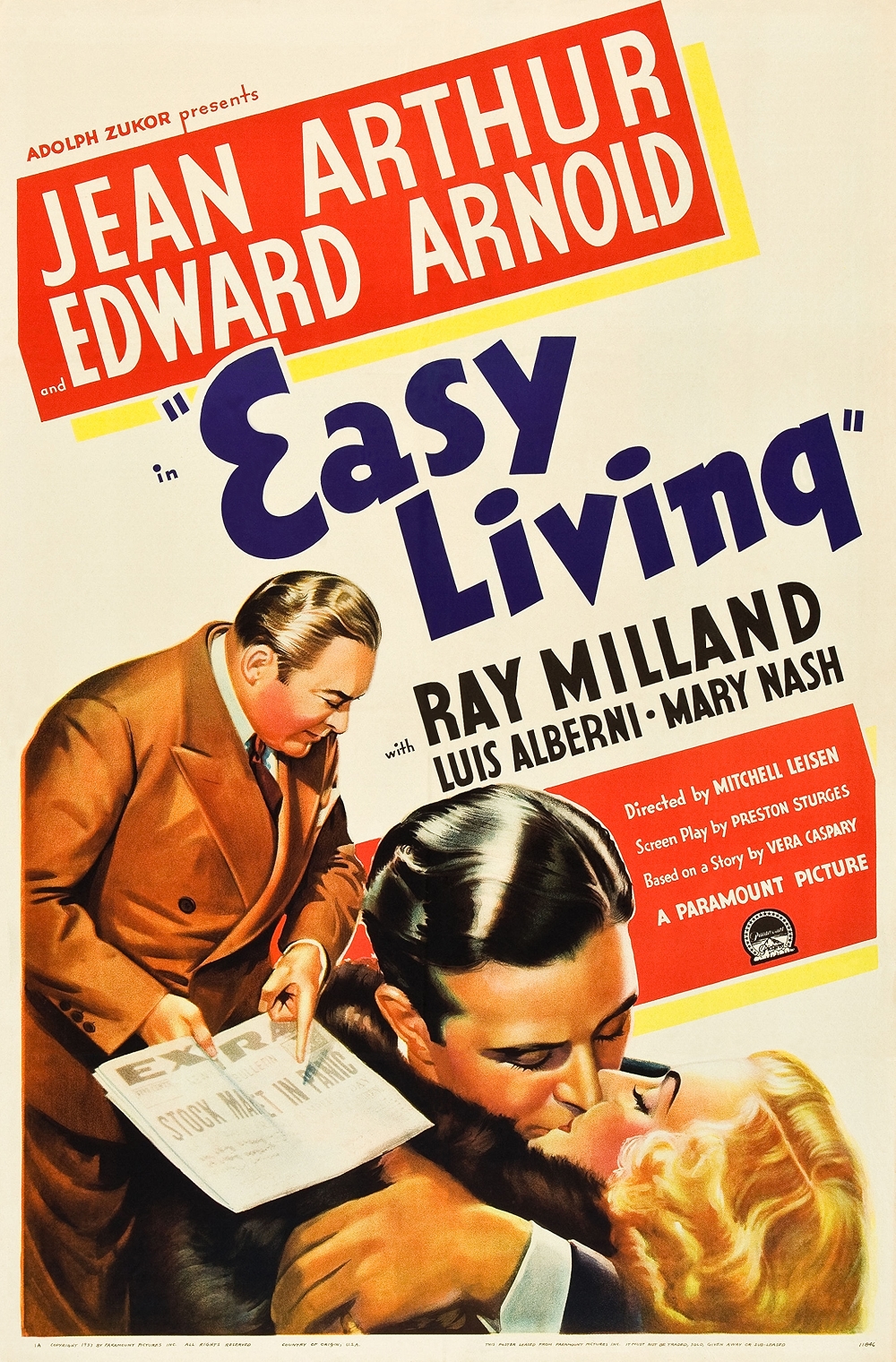
A perfect farce from 1937, Easy Living catches Jean Arthur at the peak of her career and is so devilishly constructed that explaining the plot would be a fool’s game.
But the gist of it is that a normal young woman on the top deck of an open-top bus suddenly finds herself draped in a ridiculously expensive sable coat. A banker sick of his wife’s lavish tastes has thrown it off the roof of his apartment and it’s landed on the shoulders of (un)lucky Mary Smith (Arthur). Her life is transformed, but so are the lives of the banker, the wife, their son, a couturier and a struggling hotelier, whose hotel is the venue for one of those madcap finales where identities are all mistaken, sometimes innocently, sometimes not.
Mary Smith, everywoman name suiting her appearance and character, is pretty but not beautiful, clever but not intellectual, self-confident but not aggressive, sweet but not a pushover. Edward Arnold plays the banker, JB Ball – who glories in the nickname “the Bull of Wall Street”. Ray Milland is his feckless son John Jr. Mary Nash the extravagant wife. Franklin Pangborn is Van Buren, the couturier whose shop provides the geographical catalyst for all the action. And best of all is Luis Alberni, as Mr Louis Louis, the owner of a failing hotel whose fortunes are transformed when he persuades Mary to take a room – the fur coat has everyone believing that she’s not just rich but probably having an affair with the banker, to whom Louis owes a lot of money.
Director Mitchell Leisen spins them all together in a plot that would be horror if it weren’t farce. The genres share similarities – brains working frantically but not wired entirely right, fate taking a controlling hand, events tumbling towards an often frenzied finale where a wonky sort of justice is meted out. Here, in what could very easily be horror plotting, once Mary and the coat have been thrown together, there is nothing she can do to shake it off. She tries to return it to Ball Sr, but that goes wrong, propelling Mary into the escalating farce that follows (while also sparing Mary any charges of thievery).
The screenplay by Preston Sturges is alive to the vagaries of capitalism. Why is Ball so rich? In a late sequence Sturges “reveals” the workings of the stock market, where a man with Ball’s financial clout cannot help but win because his “bets” are powerful enough to move the market in his direction. Earlier, Mary is lavished with freebies once she is installed at the hotel – to those who have plenty (or seem to) shall be given. And throughout there’s muttered commentary by the lower orders – whether it’s butlers or shop assistants – on the behaviour of their social superiors.

All this done as a footnote. It’s the potential romance that keeps the plot moving along. To prove himself to his exasperated father, son John Jr has taken a job in an automat diner – nice bit of modernity – where he first meets Mary. The two hit it off, though he doesn’t know that she’s wearing his mother’s coat and she doesn’t know he’s the son of the man who paid for it. Here we also get a flavour of Depression-era America, when a failure in the automatic equipment causes a riot among diners who are clearly starving.
A critique of capitalism done as a comedy of manners. Though thanks to the light Sturges touch – learned from Lubitsch – it never bogs down in speechifying or ideology. No prior knowledge of Karl Marx is required.
Arthur is better suited to the role than Katherine Hepburn would have been but the dizzy energy is the same. This is a film full of good performances, with Arnold and Alberni fighting it out for top honours, at top volume, and Ray Milland (who can be a bit inert) displays a boyish energy that suits the role.
A “poor imitation of My Man Godfrey,” is how Variety described this fast, funny farce. Clearly their critic was watching a different film.
Easy Living – Watch it/buy it at Amazon
I am an Amazon affiliate
© Steve Morrissey 2026