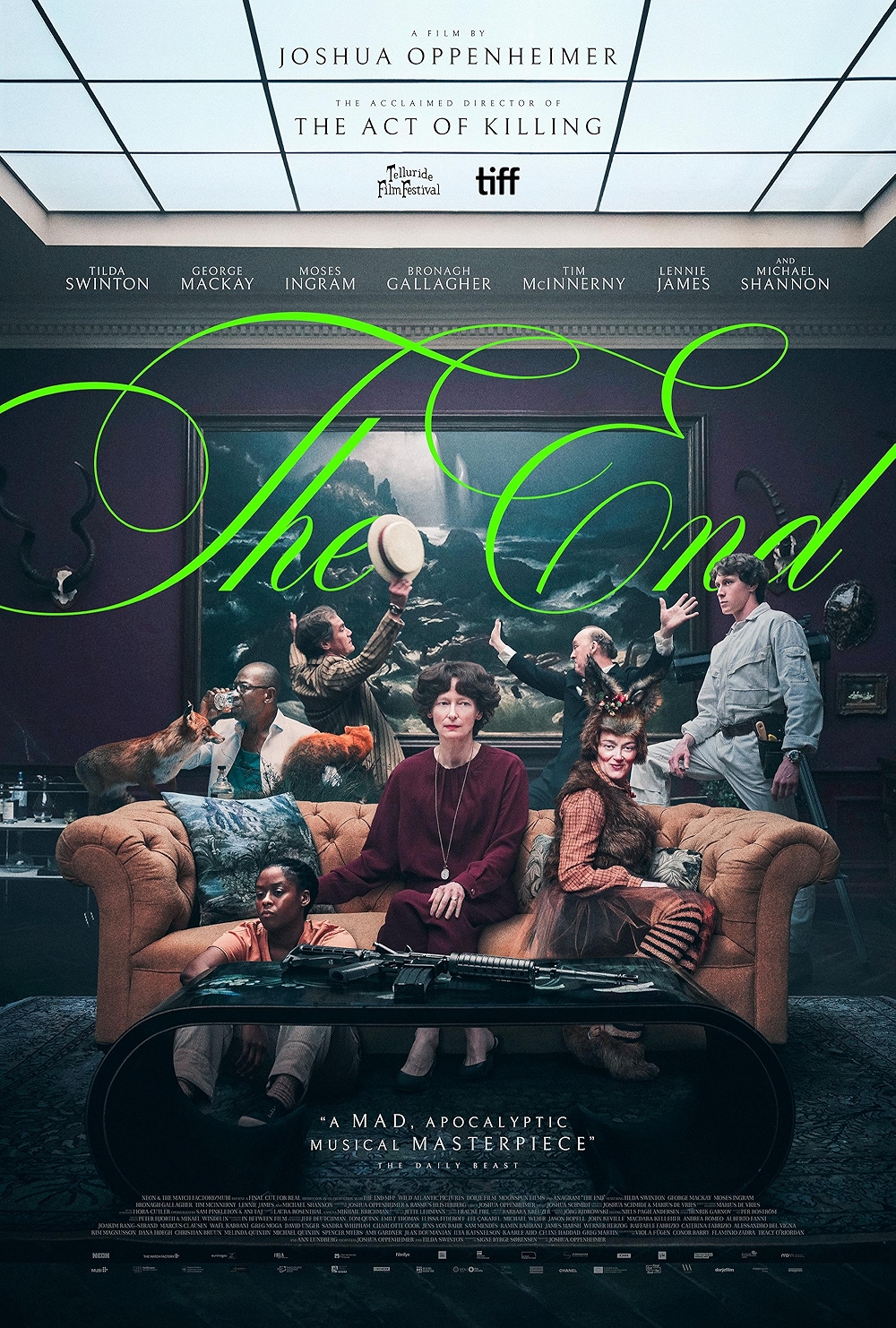
Here’s a pitch. A film about an oligarch family living in a bunker for 25 years… done as a musical! The End is Joshua Oppenheimer’s follow-up to his two documentaries about the genocidal regime in Indonesia, and should at least win awards for audacious change of direction.
Oppenheimer’s The Act of Killing and The Look of Silence both marked him out as a special talent, but those were both now ten-plus years ago and in the decade since he’s directed a couple of episodes of TV and nothing else. The End is both a return to film-making as well as a shift into fiction.
According to the man himself, what he wanted to do was make a third film about the extraordinary goings-on in Indonesia – government-sanctioned death squads, in short – but realised that going back to that country would likely result in his own death. Thwarted and depressed, he decided to sit down and watch a bit of escapist entertainment instead. The Umbrellas of Cherbourg. And then the lightbulb pinged on. What if I made a musical that somehow melded the two – the big American-style musical with something more serious, full of urgent political content.
Can that be done? Why not? Has it been done? No. The End is a fail, though you can’t fault Oppenheimer’s ambition and chutzpah. He and we join the action – what there is of it – at this oligarchical family’s underground bunker deep in an abandoned salt mine. The world up top has ceased to exist 20-odd years ago and if there’s anyone left at all, there can’t be many of them.
Down in the depths they live well. Food is grown in special areas, there is fish from tanks, they have a swimming pool and a wine cellar, the walls are covered in some of the dead world’s finest art works. But the cosy, regulated existence of Mother (Tilda Swinton), Father (Michael Shannon), Son (George MacKay), Friend (Bronagh Gallagher), Doctor (Lennie James) and Butler (Tim McInnerny) is brought to a screeching pause when suddenly, out of the blue, a new person arrives – Girl (Moses Ingram). Girl is of child-bearing age, and since the other men are either married (Father), on the payroll (Doctor) or sexually not inclined that way (Butler), it looks like Son might soon be in line for something of a physical nature.
There is a hint of a shadowy Oedipal sub-plot here, the now suddenly superannuated Father and the jealous Mother, but Oppenheimer is less interested in all this and more interested in this family’s back story. How come it’s them in the bunker and not some other group of people? What did they do to get there? Did that involve denying access to others? How are they squaring that with the ongoing job of being human, especially with each other?
Oppenheimer’s old concerns – murderous behaviour and how humans justify themselves to themselves – raise their head here. This is the film at its best. The strange way the members of this family interact with each other. The way Son, aping his father, talks in an oligarch’s terms about the progress of humanity (even though it’s largely ceased to exist), though he has barely any interest in individual people. The courteous way this family, plus hangers on, behave towards each other versus the ruthless way they deal with members of an out-group.
Father, we gather, was something in energy. Maybe he brought about the catastrophe that killed everything up top. Now he’s in permanent state of performative mea culpa but back then he did the selecting of who joined him in the bunker. Mother’s family, we gather, did not make the cut. But all this takes a long time to emerge because there is a deliberate vagueness and forgetfulness about the way everyone communicates – like guilty parties before a Congressional hearing.
This contrasted with the up-front attitude of Girl. Will they kill her? Use her as a brood mare for Son? There is something vampiric about these people.
It is brilliantly conceived but the thriller-ish aspects are undermined by a lack of pace and by acting that seems nervous… of these people, perhaps, or of the material? And the songs – maybe you forgot it’s a musical, but at times you wonder if Oppenheimer has too – don’t deliver much beyond unnecessary psychological explication. They are influenced melodically and stylistically by The Umbrellas of Cherbourg, but lack Michel Legrand’s gift for doomed grandeur. Some of the cast are noticeably better at singing these downbeat ditties than other. Props to Ingram, who can properly sing, dynamically and mellifluously. MacKay has a voice and can use it. The rest of them are, you know, able to hold a tune, and have their moments. But who ever hired Michael Shannon or Tilda Swinton for their singing ability?
Tim McInnerny as Butler is underused, though his twin role as gopher and court jester does chime with the current batch of tech bros’ conception of a new society – with themselves at the apex, like a medieval monarch. But imagine hiring Lennie James – the best actor here – and giving him only a few lines.
Strange film. Worth a watch, probably more than once though sometimes the two hours 28 minutes’ running time does feel a bit like being trapped underground for 25 years.
The End – Watch it/buy it at Amazon
I am an Amazon affiliate
© Steve Morrissey 2025