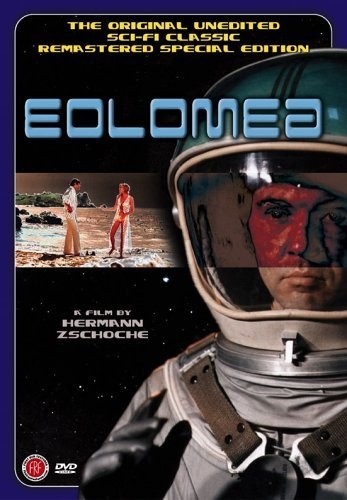
Considering it’s sci-fi from behind the Iron Curtain at the height of the Cold War, Eolomea is an unexpectedly bright, colourful, even countercultural space adventure. Some of it is still brilliant, some of it pretty dated. But it’s entirely fascinating, top to toe – this is how the East Germans were doing it in 1972.
It opens unexpectedly, with a shot of a guy running down a beach. I’ve made it, he says (in so many words), the Galapagos Islands! It’s like the beginning of an episode of TV show The Monkees. The soundtrack is surely about to break out into something bubblegummy and poptastic. Apart from anything else it completely confounds expectations.
Second surprise. The star of this film is not really the guy on the beach, Ivan Andonov’s astronaut Daniel, but Dutch actor Cox Habbema, who plays director of space operations Professor Maria Scholl.
The third one is the plot, which is strange and not entirely coherent, and starts out concerned with missing spaceships but ends up as a story about a new generation of pioneers heading bravely into space towards the fabled planet of Eolomea to spread humanity/communism/whatever. Where no man has gone before etc.
The action divides fairly cleanly. On Earth, Professor Scholl tries to get to the bottom of the mystery of the disappearing ships and their crews, figuring the mysterious Professor Tal (Rolf Hoppe) might be somehow involved. Up on a space station Daniel and veteran astronaut Kun (Vsevolod Sanaev) wax philosophical about life and the universe, with unkempt Daniel clearly the more cynical of the two.
Periodically the action shifts back to the Galapagos (the Bulgarian Black Sea coast in reality) where Daniel has always dreamt of spending some time. Whether these are fantasies, flashbacks or forward projections is a little unclear, but on several of these digressions Professor Scholl is there too, either to debrief Ivan or to provide more recreational services – this also doesn’t seem entirely clear.

Professor Scholl is unexpectedly leggy and sexy for a scientist in charge of a space agency. In case we hadn’t spotted that Cox Habbema is a babe, Professor Scholl is regularly kitted out in the sort of clothes a Cher tribute act might wear. These outfits are quite a distraction – how long did those white knee-length sandal/boots take to lace up? – but they do at least provide a contrast to all that rocket hardware.
Less facetiously, there is an ideological aspect to some of the costumes. Images out of Nasa Mission Control in Houston at the time were wall to wall with white-shirted white men with buzzcut and headset. They all looked the same. Here, a woman sits at the apex of the East German space operation, and beneath her an ethnically diverse mix of men and women in colourful clothes and happening hairstyles go about the same business. This is the anti-Nasa.
There are touches of Star Trek in the optimism and humanism, but also Kubrickian moments of mystery and psychedelia, while Gerry Anderson TV shows like UFO seem to provide inspiration for some of the outfits and the model work. 1972 is the same year as Silent Running and Solaris and while the read-across from dishevelled Daniel to Bruce Dern’s countercultural astronaut Freeman is easy, it’s more of a struggle (though still just about possible) to connect up Daniel with Tarkovsky’s philosophical space adventurer Kris.
The special effects are all over the place. Some are great – especially the optical psychedelic stuff – but the practical effects are often woeful, the low point coming with the arrival of a sentient robot that’s little more than a bag of bits. Everyone around it looks faintly embarrassed. That said, this is in general a fabulous looking film, thanks to the sharp and clean cinematography of Günter Jaeuthe, the smart editing of Helga Gentz and the clean, modernist direction of Herrman Zschoche, who’s clearly taken the lesson of films like Barbarella to heart.
The post-dubbed dialogue is a terrible mistake, robbing the actor’s performances of light, shade and nuance. You can hear the acoustics of the dubbing studio. But in a way it’s in keeping with the overall slightly “off” feeling about the whole film, whole chunks of which remain unexplained even as the end credits roll.
The best way to watch this slice of the extraordinary is probably on Eureka’s new collection of East German sci-fi movies – Strange New Worlds: Science Fiction at DEFA, where it’s packaged with The Silent Star, Signals: A Space Adventure and In the Dust of the Stars. If it’s available where you are, it’s time to boldly go!
Eolomea – Watch it/buy it at Amazon
I am an Amazon affiliate
© Steve Morrissey 2025