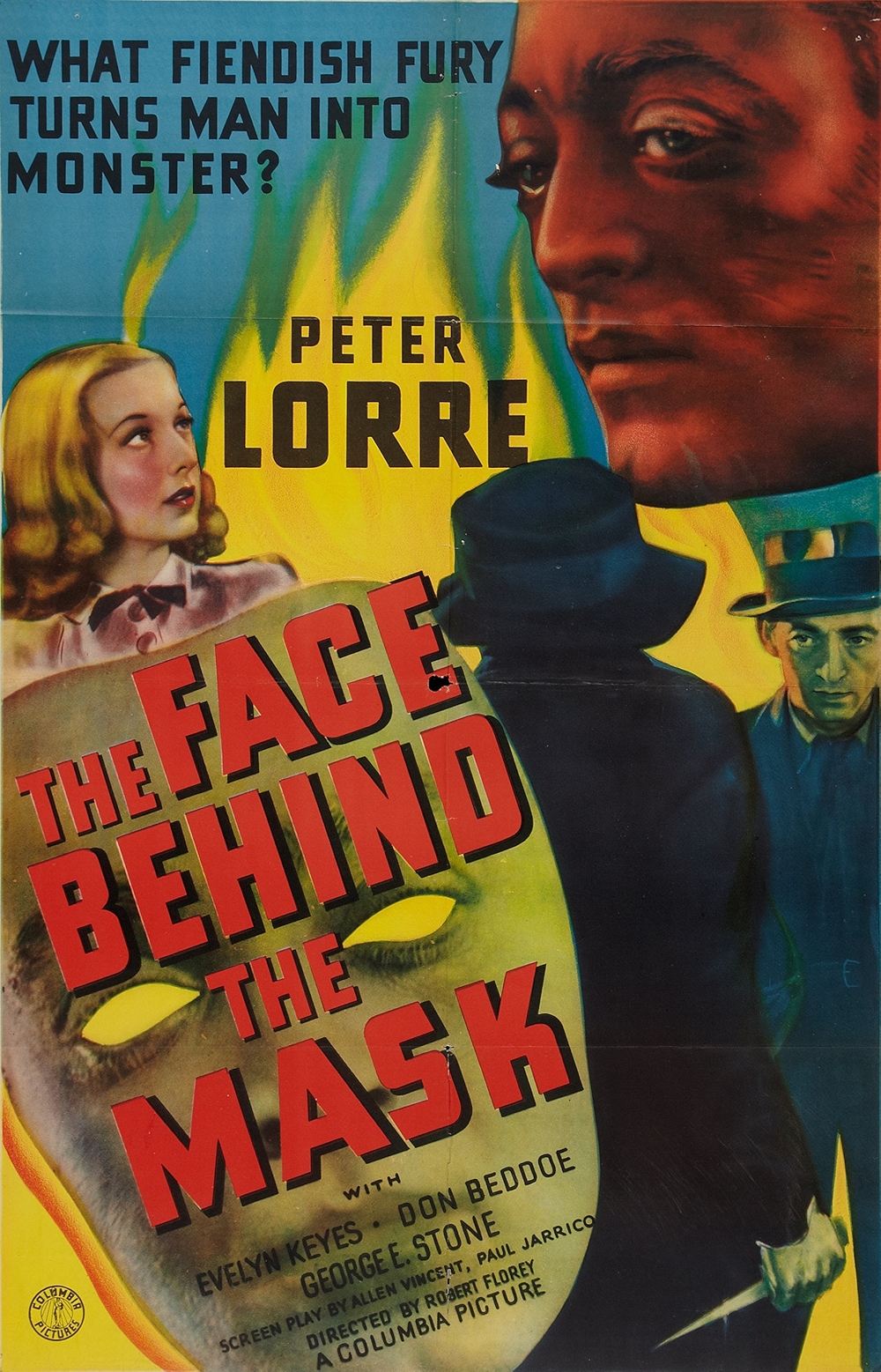
Playing the child murderer in Fritz Lang’s M bought Peter Lorre his ticket to Hollywood, where he soon tired of playing exotics and weirdos. He was already Hollywood’s go-to creep when he made The Face behind the Mask in 1941. It follows a naive watchmaker who arrives in New York off the boat from old Europe, gets horrifically burned in a hotel fire, then, unable to get work on account of his looks, embarks on a life of crime to pay for reconstructive surgery. Both a wild gothic-crime story and an an invitation to overact, Lorre gives it both barrels.
The story gets wilder once Janos discovers that surgery will be impossible. Instead, switching to Plan B, he commissions a mask, using his ill-gotten wealth to make it the very finest one money can buy. It looks almost exactly like Peter Lorre’s actual face (because it more or less is). This beauty and the beast story comes complete with a moral kicker, because once Janos meets pretty blind woman Helen (Evelyn Keyes) – who cannot see how hideous he is and loves him for what he is etc – he attempts another change of direction. Putting Plan C into play, he tries to go straight and settle down. But fate and his old gang aren’t going to let him go that easily.
There’s a lot of plot but it’s done at speed (just off one hour ten minutes), with vivid characterisation. The only real niggle is Lorre’s acting at the beginning. Janos – he goes by Johnny once he’s masked up – is wide-eyed when he gets off the boat, a wetback, but Lorre overdoes it to such an extent that Janos seems educationally subnormal. Somehow this idiot who’d clearly never be able to learn anything becomes, in a few swift scenes, a master of the criminal underworld.

The man transformed by the mask, who yearns to be his old self again once he’s found love. Director Robert Florey makes it a mostly tasteful affair, suggesting the extent of Janos’s disfigurement in early scenes via reaction shots – the horrified nurses, when the bandages come off, say it all. The mask itself is very good, prefiguring the one in Eyes without a Face to some extent, though this is far less obviously a real mask, if it’s a mask at all (it’s probably Lorre playing at statues with a waft of make-up to suggest where the mask ends).
This is a good-looking film, shot by the excellent Franz Planer, who later did Roman Holiday and Breakfast at Tiffany’s, and he gives Robert Florey huge pools of darkness punctuated with light to illuminate a point of interest. It is also well cast, for a B movie – George Stone as Dinky, the weaselly petty crook who first introduces Janos to the life of crime. Don Beddoe as the kindly New York Irish copper who takes Janos under his wing on his first day in the USA. James Seay as Jeff, the grudge-harbouring gang leader Janos usurps, and Evelyn Keyes, as the traditional wife-in-waiting who wants to live out of town in a house with green shutters and have lots of children. Keyes’s performance is particularly ambiguous – does Helen know that Janos is a criminal? There’s a suggestion that she too is wearing a mask, of wilful ignorance.
There is a lot of plot packed into a small space and a moral lesson about… not being a bad person, with the usual Hollywood tendency to equate criminality with immorality going unquestioned. For all his early over-acting, Lorre is convincing as a broken man once the extent of his disfigurement becomes apparent, and as a criminal once Janos puts on the mask and becomes Johnny. Whether you will buy these transformations at the psychological level is a whole other matter entirely.
The Face behind the Mask – Watch it/buy it at Amazon
I am an Amazon affiliate
© Steve Morrissey 2025