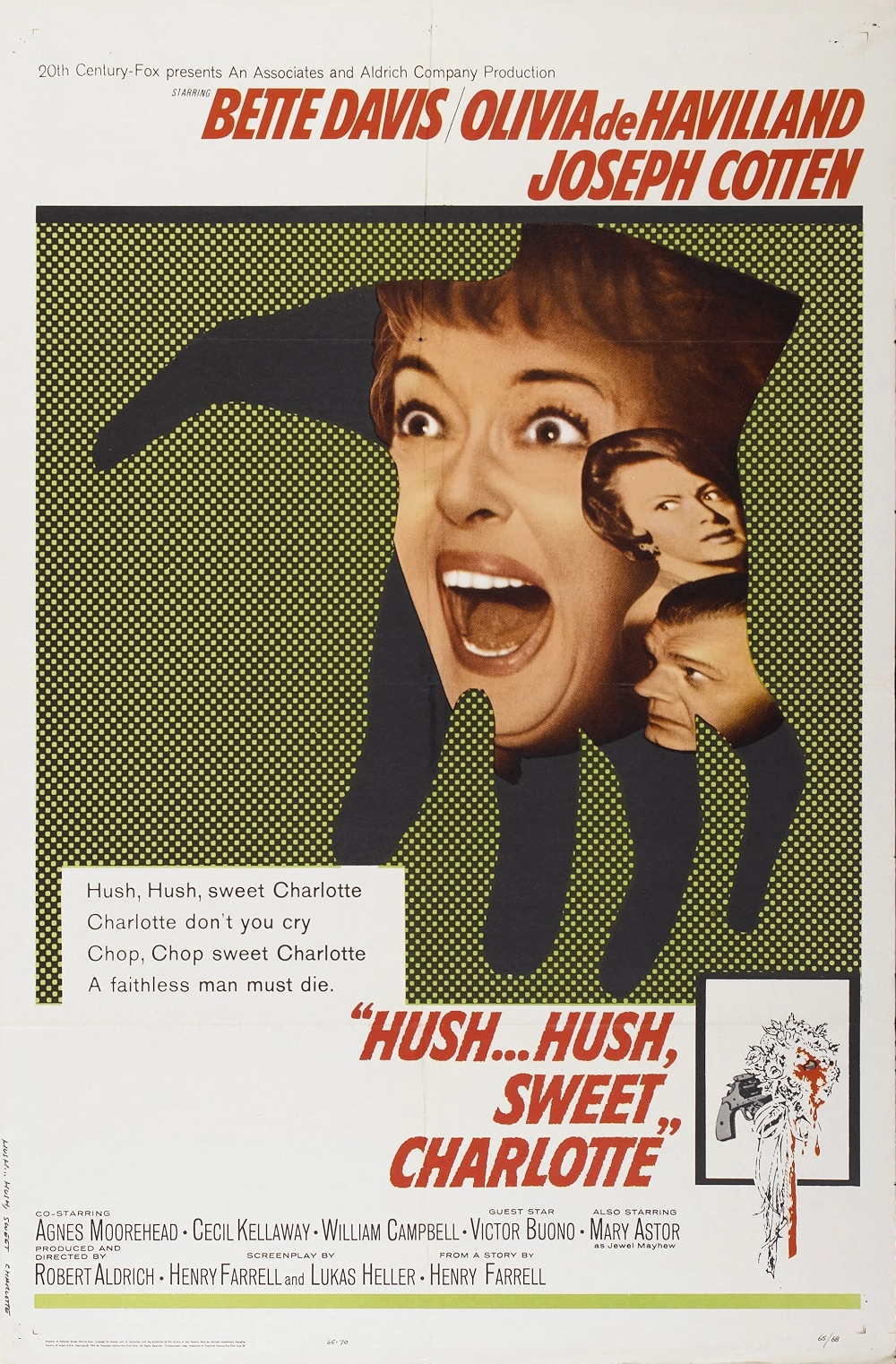
Hush…Hush, Sweet Charlotte tries to recapture the lightning-in-a-bottle that was What Ever Happened to Baby Jane? And fails. It’s not even a valiant fail, instead director Robert Aldrich and co cynically re-run the same basic idea – two vintage dames doing battle most foul – but this time around one essential ingredient is lakcing. Joan Crawford.
Bette Davis is here, though, the other half of the duelling duo who’d made Baby Jane‘s so memorable. Crawford walked off the production of this follow-up claiming to be ill. Eventually the insurers demanded she be let go. Or that’s how the story goes. It’s just as likely that Bette Davis orchestrated her exit.
If you remember Baby Jane it was the story of two sisters at war with each other – vile former child star Jane (Davis) and the paraplegic sister (Crawford) Jane loves to torment.
Grand Dame Guignol is what these things full of superannuated Hollywood monsters are known. This time around Davis plays the victim, of sorts, a woman tormented by the memory of the murder of the married man she was about to run away with decades before. When he told her their elopement was off she took an axe to him. Or that’s what everyone believes.
Aldrich and screenwriter Henry Farrell (who’d also written Baby Jane) start the action off in the 1920s and the night of the murder – done as a homage of sort to the shower scene in Psycho – before zipping forwards in time to the present day, where a deranged Charlotte now lives a Miss Havisham-like existence in the same house, serviced by her faithful servant Velma (Agnes Moorehead), attended on by local doctor Drew Bayliss (Joseph Cotten) and fighting to save the family home, which developers want to pull down.
Enter Miriam (Olivia de Havilland in the role vacated by Crawford), the poor relation arriving just in the nick of time to help Charlotte fight to keep the house, or so she believes. In fact Miriam has other plans, involving the good doctor and the family fortune, something that Velma spots pretty quickly but Charlotte – half demented – doesn’t quite grasp.

At this point in her career, Bette Davis as a victim is always going to be a hurdle, but Davis rises to the challenge with a blazing performance full of physical energy. She has surrounded herself with her friends – de Havilland, Cotten and Moorehead were all chums, as was Mary Astor, who plays the widow of the murdered man as another Havisham character, tragic and solitary. All are good. De Havilland’s part is underwritten, while Agnes Moorehead, determined not to be outdone by Davis, gives as good as she gets in her scenes, chewing through whatever’s in her way and making more of Velma than sits on the page.
There’s also Cecil Kellaway, as a kindly old British insurance investigator, who’s poking around trying to find out why no claim was ever made on the dead man’s life – the key to the whole thing. A lovely performance full of gentle nuance, offsetting the histrionics of most of the rest of the cast. And Bruce Dern, in a small but significant role as the would-be eloper who winds up with an axe as a playmate.
If the film is anything it’s an exercise in American Gothic. The creaky old house, blood-curdling acting, a wasting illness, spooky apparitions, drugs, hallucinations, a harpsichord on the soundtrack, mature women dressed in children’s clothes, thunder and lightning, long flowing nightdresses, stuffed animals, a severed head… and on it goes.
For all its excess it feels too calculated to really hit home, and the humour (inadvertent) generated by the Davis/Crawford stand-off in Baby Jane is absent here. De Havilland is just too decorous and Miriam’s true nature is too well concealed for most of the film to generate much heat.
It looks great though. Aldrich’s DP is Joseph Biroc, of It’s a Wonderful Life and Forty Guns fame, and the editing by Michael Luciano, who is partly responsible for the crisply modern look of Aldrich’s movies around this time – though it’s in black and white, this film is snappy and tight and brilliantly paced.
Tennessee Williams is in here somewhere but whatever charges you might level against these tragic, ancient Southern belles at least they have agency. Misogynistic? Add it to the list of Aldrich films that could be accused of it – he’d follow up four years later with The Legend of Lylah Clare and The Killing of Sister George, then Whatever Happened to Aunt Alice? (which he produced but didn’t direct), none of which paint a glowing picture of womanhood.
Hush…Hush, Sweet Charlotte – Watch it/buy it at Amazon
I am an Amazon affiliate
© Steve Morrissey 2025