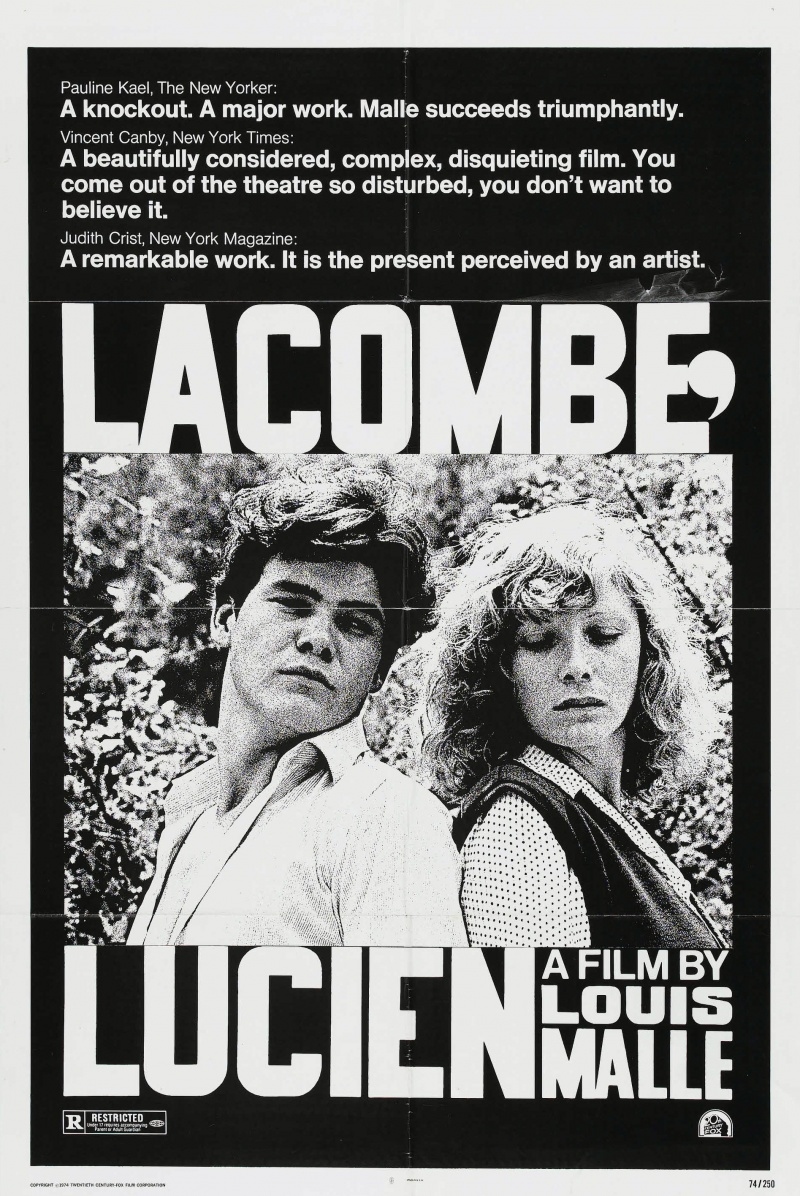
En route to winning the Nobel prize for literature in 2014, Patrick Modiano co-wrote Lacombe Lucien with Louis Malle, not only a pitiless study of sociopathic human behaviour but a rebuttal of the dearly held notion in France that amost everyone during the Second World War was in the Resistance.
It did not go down well with French critics when it came out in 1974, who saw Modiano and Malle’s portrait of young Lucien Lacombe for what it was – a barely coded indictment of the motherland.
It’s massively immersive, as no one ever said back then, and invites audiences to slip into its world as if into a great novel. Against a detail-rich portrayal of rural life in South West France, Malle delivers a sweep of idiosyncratic characters with an Altmanesque technique – stuff overlaps, people come and go, there’s a loose informality that seems almost accidental.
At the centre of it a remarkable performance by the broad-faced, handsome but frighteningly blank Pierre Blaise as Lucien, a surly peasant kid who dearly wants to join the Resistance, or so he says. But when he’s rejected by the local organiser, who suspects that Lucien is more interested in killing people than saving France, Lucien goes over to the other side, joining the collaborators and their Nazi overlords instead. His first act is to shop the Resistance recruiter who’s just rejected him.
As part of his new life as a Nazi collaborator, Lucien is introduced to Albert, a Jewish tailor, and his pretty young daughter, not for nothing named France. The “stingy Jew” – as he’s described to Lucien – has skills which give him a degree of protection. But not that much. Using Albert’s delicate situation as a wedge, Lucien insinuates himself into the lives of Albert and France, escalating his transgressions all the time – mockingly pally with Albert, making amorous advances on France in front of her father. The scenes of this kid playing with Albert and France as a cat plays with a mouse form the bulk of the story and have a queasy power. Eventually, it seems obvious, Lucien has to die.
But then Malle pulls us back a touch and asks us to consider Lucien as a human being. Without giving too much away there is a redemptive turn. Not 180 degrees but just enough so Lucien can be seen from another angle, as a young man with a misapplied skillset.

It is deeply humane storytelling. Against the amoral blankness of Blaise’s Lucien, Holger Löwenadler puts in a rich performance as Albert, the cultured and decent father trying to hold it all together for the sake of his daughter. Aurore Clément, as France, is the thing at stake. Does France feel something for Lucien? There is a cryptic ambivalence to Clément’s performance, her first in film.
Adding massively to the novelistic sense is Tonino Delli Colli’s cinematography. His films of this period, like The Decameron and Once Upon a Time in the West, have a formidable solidity, an almost 3D quality. That’s what we get here. And his incidental cinematography of the surrounding countryside and its daily life in all its lush superficial beauty provides an ironic backdrop to Lucien’s increasing malevolence.
Is Lucien Lacombe mad or bad? Or is he neither, just a kid who exploits his own self-interest and doesn’t give much of a stuff about the bigger political picture? Whichever one of those it is, Malle has given us a chilling portrait of a detached individual, a powerful asymmetric love story and a warning from history that’s highly engrossing and richly rewarding.
Lacombe Lucien – Watch it/buy it at Amazon
I am an Amazon affiliate
© Steve Morrissey 2025