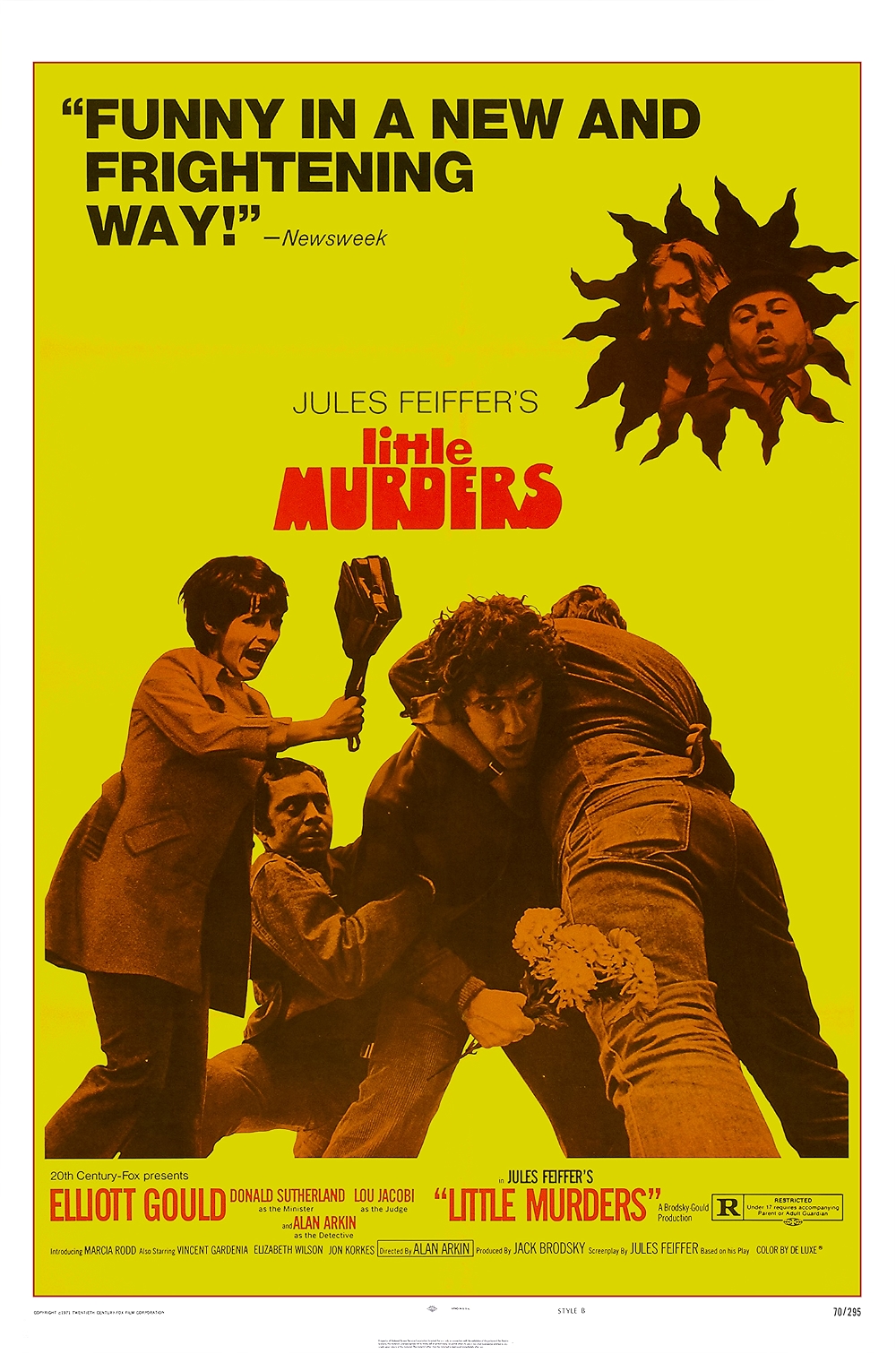
1971’s Little Murders gets the jump on Annie Hall by a handful of years. Woody Allen’s 1977 film was originally going to be called Anhedonia (an echo remains in his ultimate title) and was about a guy who couldn’t feel anything, which is what the condition of anhedonia is. Little Murders takes the same idea in a different direction – bleaker, less digressive and only funny in a weird way.
Originally Jean-Luc Godard was going to direct but instead Alan Arkin ended up behind the camera, honouring Godard with a New Wave-style approach to the material – fast edits, scenes crashed into and out of, nothing too fancy in terms of lighting, as if the camera just happened to be in the room where the action was happening. By his side Gordon Willis, the key lighting cameraman of the 1970s (pick a fight with the Godfather trilogy, Manhattan and All the President’s Men, why don’t you) who shoots so many scenes at such a level of murk that you understand fellow DP Conrad Hall’s nickname for him – “the Prince of Darkness”.
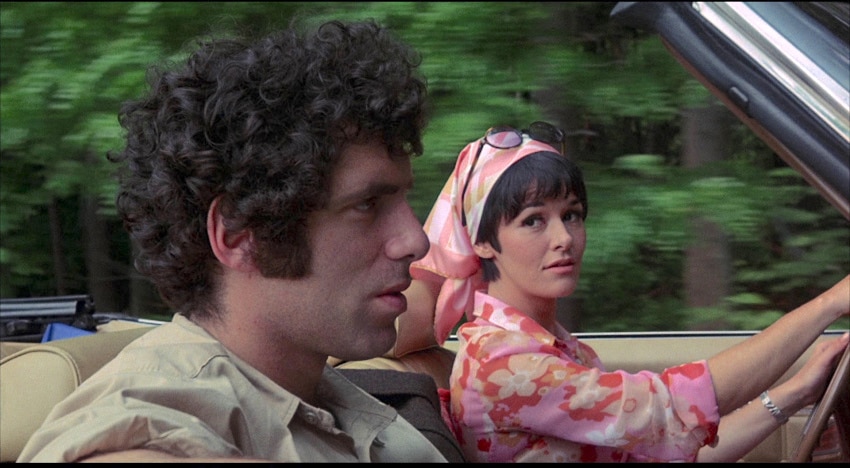
In front of the camera an entirely, absurdly, existential anti-hero played by Elliott Gould. We meet Alfred being beaten up in the street by some louts. Rather than fight back, Alfred just lies there as the blows rain down on him. Eventually a young woman steps in to help him and the louts turn their attention to her instead. Alfred, suddenly out of the melee, simply walks away, leaving Patsy to her fate.
This being that sort of film, and this also being that sort of meet-cute, Patsy falls instantly in love with the entirely passive Alfred and tries to form a relationship with him. But he has no hobbies, no interest in life apart from taking photos (the bystander’s art form). He is, in his own words, “an apathist”, “a nihilist”.
Everything in this film is a bit like Alfred. Nothing works properly. The phones, street etiquette, the power constantly failing, personal relations, everything seems to be teetering on the edge of collapse.
What does Patsy see in Alfred? It’s suggested, somewhat improbably, that she likes a challenge. He’s a “reclamation job”, she says. And also, as her father points out, all her other men have been “swish”. Arthur, for all his faults, does not seem to be swish.
Some of the film’s best scenes are at the parents’ apartment, where Patsy takes Alfred to meet Carol (how dad hates having a female name) and Marge. Vincent Gardenia and Elizabeth Wilson light up the screen with performances almost as dementedly excitable as Marcia Rodd’s as daughter Patsy, while the very funny John Korkes plays the younger son as a strange oddball who seems to have no idea where any of the boundaries are – at one point he sits almost in Alfred’s lap, not that Alfred takes any notice.
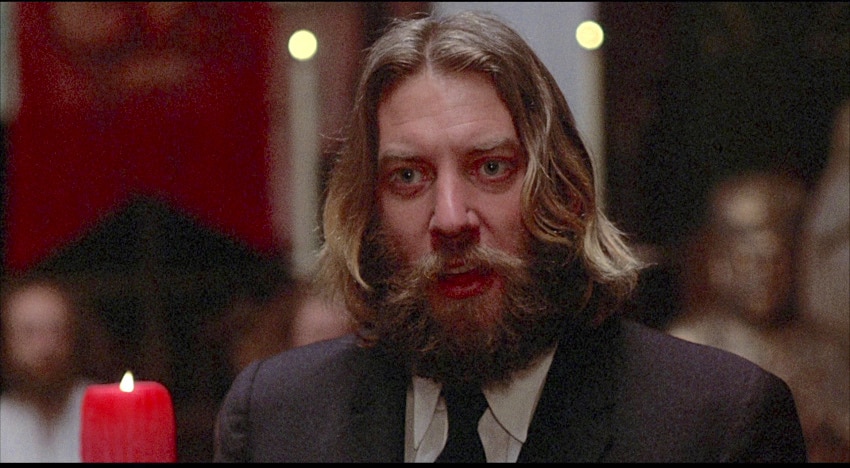
To bounce unresponsive Alfred into some sort of reaction, Patsy proposes that they get married. And so they do, at the First Existential (of course) Church where Gould’s old M*A*S*H co-star Donald Sutherland shows up for a glorified cameo as the minister who says all the unsayable things, wonders aloud if the marriage will last and shares with the congregation the fact that Patsy’s dad has paid him $250 to get a mention of God into the service, against the explicit wishes of the atheist Alfred.
Bracket this one alongside Harold and Maude for deadpan humour and weird relationships, and The Producers for its fizzing flights of fancy. It’s when Alan Arkin himself shows up as a cop called Lieutenant Practice that everything seems to drop finally into place. A character out of Kafka by way of Gene Wilder, he shouts, sobs, threatens and, in a brutal code, gives the “explains it all” speech, which, this again being that sort of film, doesn’t really explain anything at all.
Life is a cosmic joke and then you die? Writer Jules Feiffer wrote the original play as a comment on a society apparently falling apart. It bombed on Broadway in 1966, where Gould was its star, and closed after seven performances. Something about it must have grabbed Gould’s attention, though, because he bought the screen rights. In London the following year it did a lot better. And then, off-Broadway two years after that Arkin directed it to financial and critical glory – “fantastically funny” said the New York Times.
From this end of the telescope it remains distinctly its own beast though obviously of its time – the debt to the French New Wave, to Kafka and Brecht, the way it leans hard on existential ennui as a character driver. But there is a bracing forward thrust to it, thanks largely to Arkin’s fast directorial pace. And it has the confidence (foolhardiness) of its convictions, even though it’s going to alienate most of the audience. The shock ending, when it comes, fits the scenario perfectly. Dark, dark, dark and daring you to laugh.
Little Murders – Watch it/buy it at Amazon
I am an Amazon affiliate
© Steve Morrissey 2025