
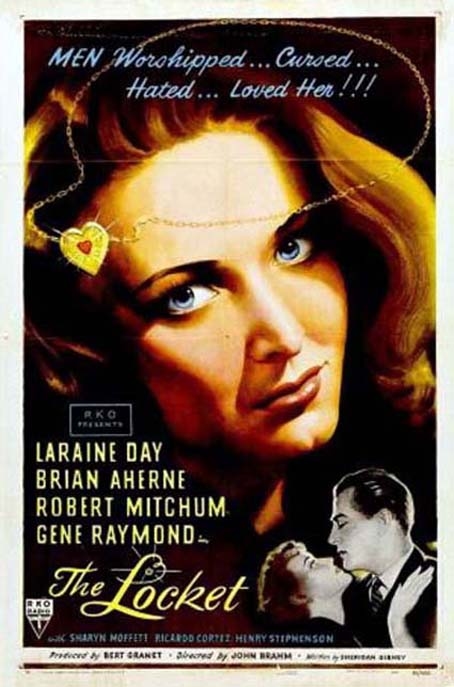
A locket opens once, to reveal what’s within. The 1946 movie The Locket, on the other hand, keeps on opening. Flashback follows flashback, with more information delivered each time the hinge creaks ajar. What’s inside is sort of special, sort of irritating. This is a film whose most difficult bits are quite easy to follow. It’s the rest of it that gets a touch troublesome.
That flashback-within-flashback structure is the film’s USP. Otherwise it’s a mid-1940s aberrant-psychology drama focusing on one Nancy Patton (Laraine Day). As the curtain rises Nancy is about to get married to big swell John Willis (Gene Raymond) at a society wedding. But then Dr Blair (Brian Aherne) sits Willis down and tells him a fascinating and shocking story, beginning with the revelation he was Nancy’s husband for five years, and that this sweet-as-pie, butter-wouldn’t-melt young woman is in fact a “horribly twisted personality”.
Back we go into Dr Blair’s flashback, where he is being sat down by a painter called Norman Clyde (Robert Mitchum), who also has revelations about Nancy. And into Norman’s flashback we also go, before diving yet again, arriving ultimately in the childhood years of Nancy, where she is the daughter of a housekeeper at a big house. It’s here that the seed of all of Nancy’s future selves is sown, when Nancy is accused of stealing a valuable locket from her mother’s rich boss. Maybe she was driven by class envy, the lady of the house suggests, or maybe Nancy is just a bad lot.
It doesn’t matter if Nancy stole the locket or not. The film’s point is that psychological damage inflicted at an impressionable age ricochets down the years. On this pivot Nancy’s life swings.
Aberrant psychology was all the rage in the 1940s, with this film an attempt to put into layman’s language how Freudians psychoanalysts describe the malformation of a psyche. Along the way meditations on stealing itself – poor people get accused of it pure and simple; rich people can pay for a fancy fallback – my client is a kleptomaniac, your honour, and should be treated compassionately etc etc.

Class is the faultline. It’s easy to be good if you’re rich and if the people with money in this movie aren’t all good, they’re good at feigning it. Look at painter Norman – struggling and honest when we first meet him but elevated by Nancy’s efforts, and getting less noble and less happy about his circumstances as he rises like cream (scum?) to the top.
Barbara Stanwyck might have played the role Day takes, the poor confused (maybe just bad?) woman poisoning everything around her. Day seems at first a touch too vanilla to be playing Nancy – a victim name straight out of Dickens – but as time goes along her casting (and Day’s wide-eyed playing of Nancy) starts to come across as inspired.
Good as Day is, the best thing in it is Sharyn Moffett as the young Nancy, whose denial of the stealing of the locket is the film’s key scene. Maybe we don’t entirely believe that the flashback is being honest about Nancy’s innocence, but in Moffett’s playing of her we understand that Nancy believes she is. As Day takes over, this juxtaposition between what Nancy is and how she’s portrayed becomes crucial, though by this point the inner and outer selves have separated entirely, with Day playing Nancy as a film noir bad girl hidden inside sweet innocence.
Whether this is really noir is up for debate but its director of photography, noir supremo Nicholas Musuraca, goes at it as if it were. This is a film full of lurking shadows, though admittedly they’re more layered and dappled than in a more unambiguous noir.
Director John Brahm handles the tricksy material with flair. We always know where we are in the flashback structure. It’s the screenplay’s fault that there are just too many people, too many switches of scenery, for the story to embed properly, and some characters (Mitchum’s, to name just one) never really get a chance to develop. It’s busy, and then some, but at least there’s plenty to chew on.
The Locket – Watch it/buy it at Amazon
I am an Amazon affiliate
© Steve Morrissey 2026




SPOILER:
The whole point of the film is that Nancy didn’t steal the locket and the false accusation traumatized her and led to her psychological downfall. It’s an important plot point to get right if a viewer wants to understand the main character.
Completely right, Charlamckinney. I’ve finessed my copy a bit. Thanks for setting me right on the plot.