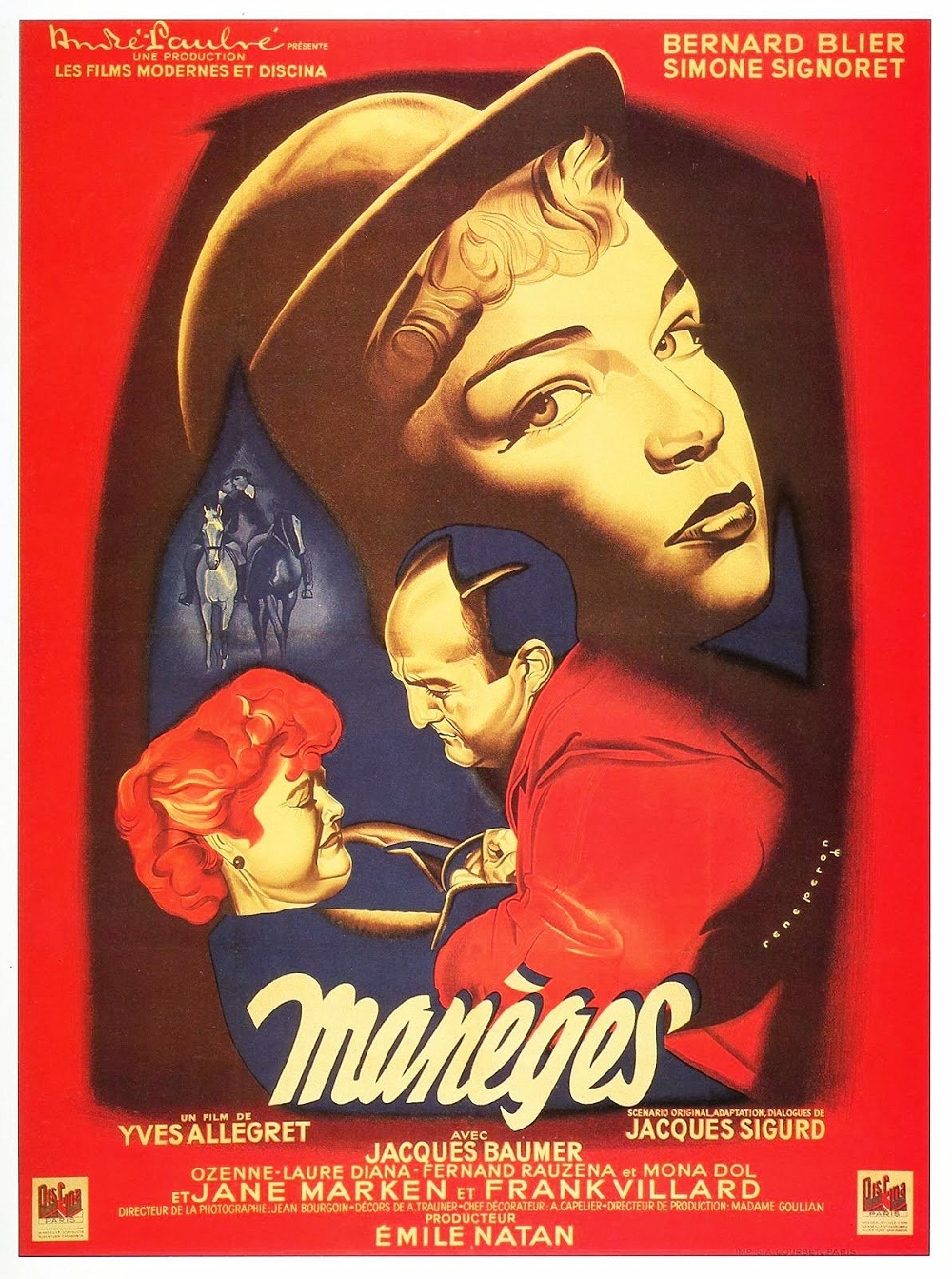
Manège is the French word for a riding school. One features centrally in Manèges (aka The Cheat), a superbly unpleasant French movie from 1949. It’s also the word for merry-go-round – worth remembering as this tale about a cuckold being given the absolute runaround plays out.
The casting is bang-on perfect. Bernard Blier as Robert, the pudgy, middle-aged owner of a riding school who has married vampish Dora (Simone Signoret) because she’s hot as hell, unaware that Dora’s mother (Jane Marken) has engineered the marriage for reasons of her own.
The story plays out in flashback, from the hospital where Dora lies mortally injured after a terrible accident. While Robert twists his knuckles with worry at Dora’s bedside, Dora’s mother casts looks in his direction suggesting the accident was all his fault.
A series of iris dissolves back to the past gives us the real story of Robert and Dora together, he running a successful riding school and she living the high life, gradually siphoning money out of the business. En route to destroying Robert financially, Dora largely does what she likes. When she’s not out riding with one gentleman or another – grudgingly, she tells her husband, claiming it’s good for business – she’s usually in the company of her mother. The two are thick as thieves.
Because, it is eventually revealed, that is what they are, a pair of conwomen who are systematically taking Robert to the cleaners. Dora, meanwhile, is also using the riding school as a great place to pick up a ride, of one sort or another, using her mother’s place as cover when she wants a night of fun. Has anyone ever looked sexier in riding gear than Signoret here?
This is the era of the femme fatale and in Dora we have one of its most savage. Even mortally ill, bathed in sweat on what may be her death bed, Dora looks like a pampered courtesan. And guilty, guilty as hell.

The film is often accused of misogyny. Maybe. Dora is a vile creature and her mother is even worse. But director Yves Allégret and writer Jacques Sigurd also conjure up sympathy for the younger woman. Dora, it turns out, is quite sentimental and she’s hopeless when it comes to men, forming attachments only with those who are going to be bad for her (so doughy Robert is right out). If there is a theme in her life it’s being treated badly by the opposite sex.
Let’s switch focus for a second. What about Robert – what a pitiable creature he is. What a sap, what a fool, how long before the centime drops? “I love her… the filthy bitch,” he says at one point as the full extent of Dora’s transgressions starts to become obvious after she, convinced she is dying, encourages her mother to tell Robert everything. Misogyny/misandry – take your pick.
Best thing in it by a country mile is Marken, as the reprehensible mother. What a performance. That wicked cackle. Imagine your own mother as your pimp. Marken makes it feel as unsavoury as it sounds. And, her moral opposite, as Louis, Robert’s riding master – who sees all and disapproves – a ramrod Jacques Baumer.
“Film noir” and “femme fatale” are both French expressions, of course, and here Yves Allégret gives an object lesson in both. His camera is beautifully fluid, even in the tight spaces where much of this story plays out. There is a 4K restoration of the film, which is worth seeking out if you’re interested. The image is pretty good – Allégret worked under Jean Renoir and there are soft, poetic Renoir-esque touches here and there, though for the most part he keeps it running on noirish rails.
A sordid, beautiful and strangely under-discussed film that’s worth a lot more attention.
Manèges – Watch it/buy it at Amazon
I am an Amazon affiliate
© Steve Morrissey 2026