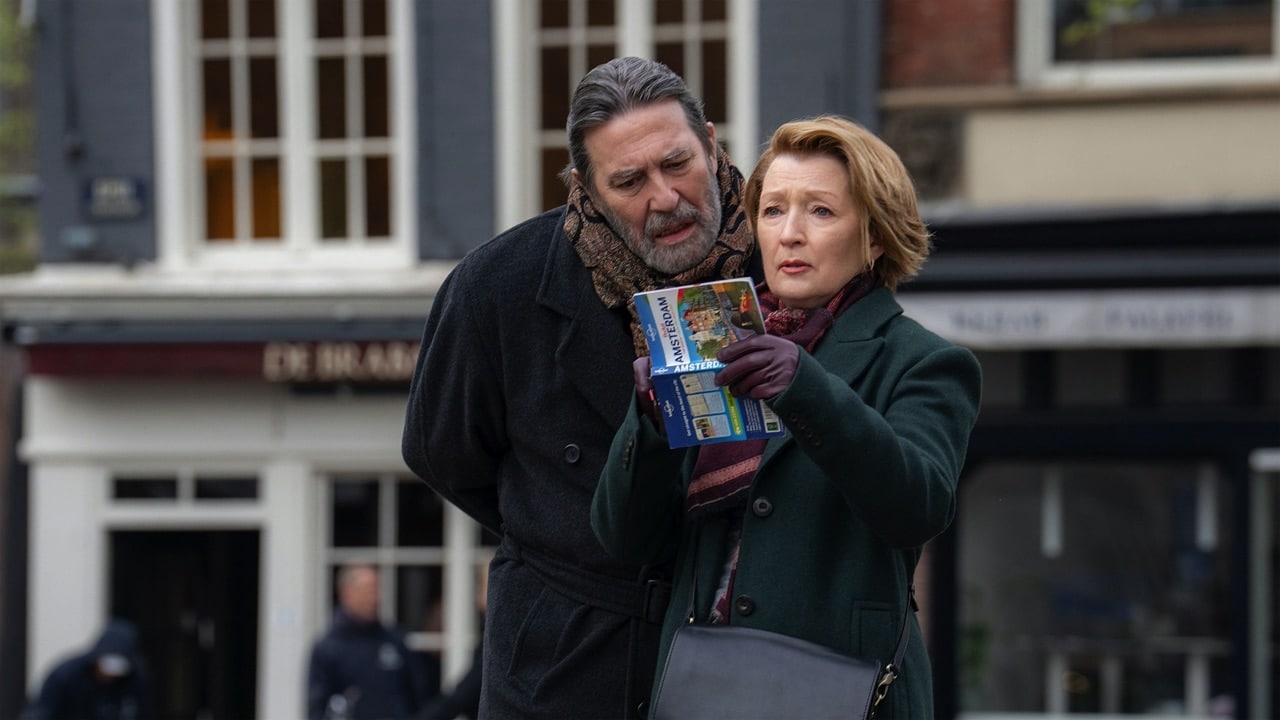
Unfashionable and not particularly worried about it, Midwinter Break is a showcase for the acting talents of Lesley Manville and Ciarán Hinds, who play a long-married couple taking a city break in Amsterdam. She bought them both the trip for Christmas and if he’s being honest he probably didn’t want to go but is not saying so. Because? That’s your film.
A bit of infill. Stella and Gerry are originally from Northern Ireland but relocated years before to Scotland, after she got caught by a bullet during the Troubles. She was pregnant at the time. The child survived, but her ability to have more kids was taken from her. Now, Stella’s daughter is all grown up and has a life and family of her own, and Stella is worrying about her role in life. What is the point of her existence? If Gerry’s having similar doubts, he’s drowning them in whisky.
And so they’ve gone to Amsterdam, in winter, at her prompting, to do the things that people do – visit the galleries, walk along the canals, take a peek at the red light district and enjoy the bars and restaurants. Have fun.
Polly Findlay’s movie experience consists mostly of directing livestreams to cinemas from the National Theatre in London. She lets her actors get on with it, lets them build a portrait of a marriage that is now possibly surviving only on performative display. Stella and Gerry have their pet names and in-jokes, little rituals they fall back on to fill in moments of the day. Having a drink together, they toast each other. “You and me,” he says. “Me and you,” she chinks back.
Of course that’s not the entirety of the film but in many respects these are the best bits of it. There is, as it seems there must be, a crisis and Gerry and Stella are eventually forced to confront the aridity of their life together. She wants more than just all this, a more spiritual approach to life, and he, in his different way, wants the same thing – the oblivion of the self. But it’s the build-up rather than the release that’s so fascinating, watching these two very precise actors construct a story out of their characters and their malfunctioning though cosy life together, and by what’s not said as much as what is.

In a way Stella and Gerry are finding different answers to the same problem – existential angst – a dish usually served up by young people wondering what it’s all about. Seeing two older people – both actors are around the 70 mark – wrestling with it is refreshing and maybe slightly perplexing. You’ve got this far, can’t you just carry on the way you were?
Findlay does not push this aspect of it, and in fact lays back a touch with the judgmentalism, allowing Manville and Hinds to present us with portraits of two slightly bewildered people at what might be a crossroads in their life. The score, by Hannah Peel, of tentative harp and piano, does the same.
But that is part of its unfashionable appeal. Essentially a two-hander, this could easily be a play, and what with Findlay’s credentials, and the adaptation by theatre writer Nick Payne, it’s tempting to say that that’s what it is. Which will irritate the contingent that believes there’s no room on screen for this sort of thing (see also, recently, Steven Soderbergh’s The Christophers, another two-hander and no worse for it).
They have a point. A tiny one. This is not a barnstormer but there is emotion here, beneath the surface. Maybe it runs out of puff a touch before the end. That bang-on 90-minute running time giving the game away?
Midwinter Break – Watch it/buy it at Amazon
I am an Amazon affiliate
© Steve Morrissey 2026

