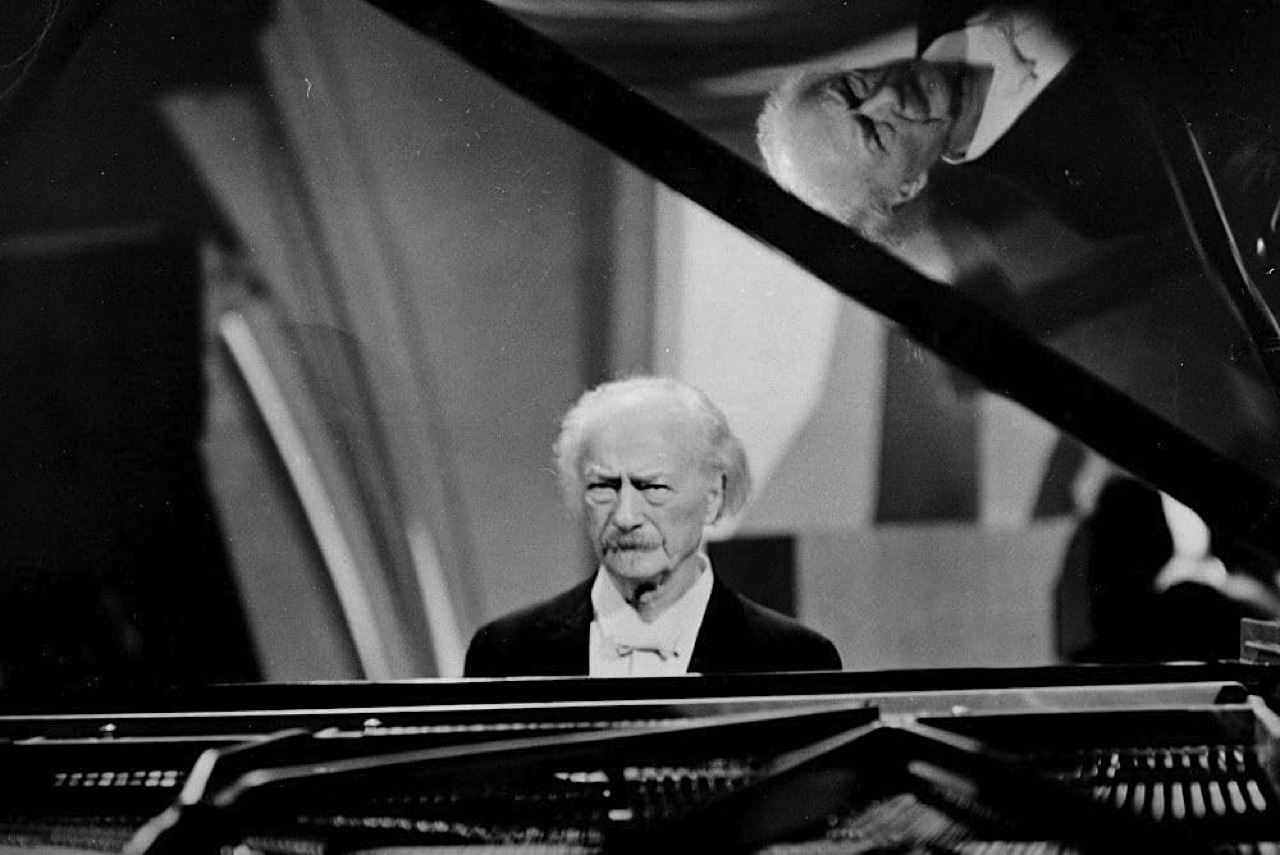
It’s not often that you get to see a former prime minister in an acting role. Or a great classical pianist, for that matter. In 1937’s Moonlight Sonata you get both, and in the shape of a single person – Ignacy Jan Paderewski, the Polish pianist who gave up his music career to serve his country as prime minister, then gave it up again decades later when his country repeated the call during the Second World War.
There are two films awkwardly sandwiched together here, both featuring Paderewski, who’s functional in the first, ornamental in the second. The first opens with 20 minutes of straight-up footage of Paderewski playing in a concert hall. In a showy performance, the epitome of the old-school maestro with swept back hair gives us fireworks with Chopin’s Polonaise No. 6 before encoring with Beethoven’s limpid Moonlight Sonata. Director Lothar Mendes tries to introduce some dynamism with expressionistic angles – it’s an art nouveau hall so it’s about right – but visually it’s hardly dynamic, but then it doesn’t need to be.
Then, after an awkward segway in which Paderewski tells admirers gathered around him that he’s just the instrument of this powerful force of music – etc etc – he goes on to illustrate what he’s talking about with a little tale.
Here beginneth the second film, an operatic plot about a baroness and her pretty grand-daughter, a servant who would like to marry the young woman, and a cad who threatens to steal her away.
Paderewski features only incidentally in this one. After the light airplane the pianist is on malfunctions, the pilot is forced to land in a hurry, and does so in the grounds of a Swedish castle. This brings Paderewski and fellow passenger Mario de la Costa (Eric Portman) into contact with the chatelaine, Baroness Lindenborg (Marie Tempest), her young grand-daughter Ingrid (Barbara Greene), who is about to come into an inheritance, and estate manager Eric (Charles Farrell), who is in love with Ingrid, has no interest in her money and is hoping she’ll say yes to his proposal of marriage.
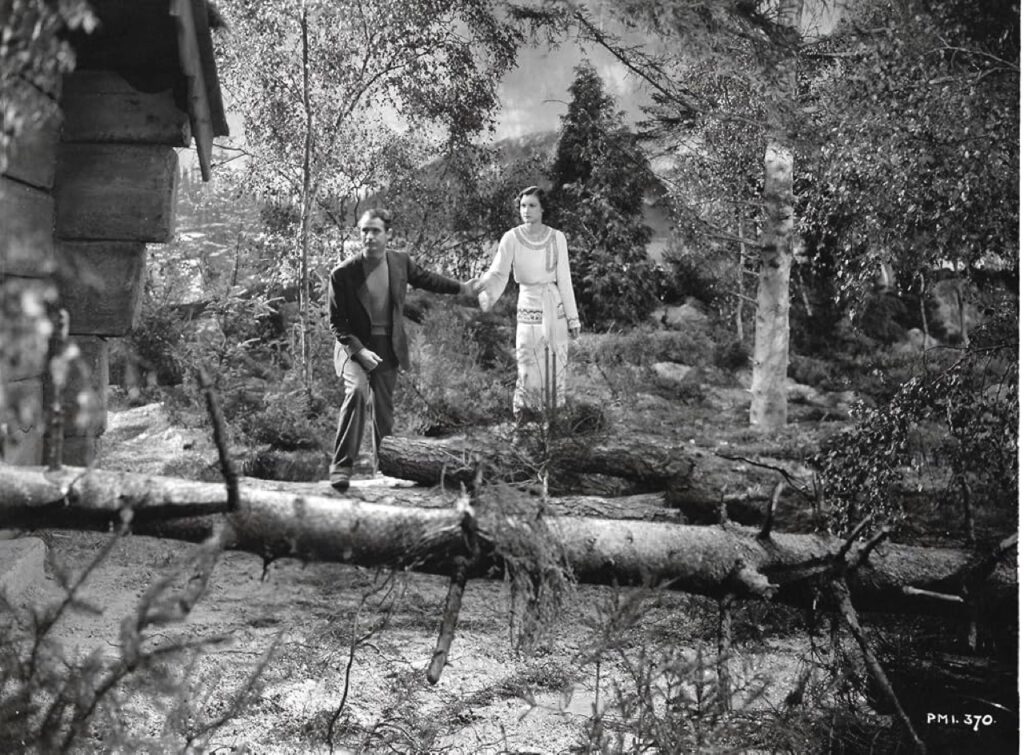
Mario, however, isn’t cut from the same virtuous cloth. We know he’s a bounder from the first glimpse of him – who flies in evening dress? He’s the driver of this amusing if slight story of entitlement versus deference, de la Costa using status and entitlement to insinuate himself between Eric and Ingrid. This infuriates Eric, sends frissons of lust coursing through the veins of Ingrid, who had been on the point of agreeing to marry decent but dull Eric, and both amuses and annoys the Baroness, who is on to Mario from the first glimpse of him.
This story functions like an advert for the aristocracy. Smart and virtuous, its embrace of high culture is the signifier of its superiority (quite a philosophical sell considering that the Nazis were already bundling people into concentration camps at this point, weeping to Beethoven and Brahms as they did so).
The acting is formidably good, particularly Portman as the caddish Mario – a slap in the face coming his way, surely. Marie Tempest as the Baroness is so regal that if you were setting up a country with a monarch as its head of state, this Baroness would fit the bill – wise, clever, gracious, elegant.
Paderewski is stiff, but gets away with it because he’s Paderewski. At one point the entire party decamps to the orphanage founded by the Baroness (natch). There, the children’s teachers, who have no idea who this kindly white-haired gentleman is, ask him if he’d be capable of playing some music for them. The music open on the piano happens to be Paderewski’s Minuet in G. The great man shrugs with an air suggesting he might just about be able to manage it, and gets a laugh.
Getting more laughs is Queenie Leonard as the frightfully silly Margit, who swoons and gets giddy at every glimpse of Mario. File her under comic relief, but a very good one.
Of course Mario is not what he is claiming to be – he turns out to be in trade, which will never do, and also already married, which seems almost the lesser of the two disqualifications.
Eventually, scales forcibly ripped from Ingrid’s eyes, she goes back to Eric, the poor girl clearly only having two choices in life. Paderewski is playing the Moonlight Sonata again as she does so, and he does it so beautifully the dénouement comes across like a romantic triumph rather than some sort of tragedy. What a bizarre, fabulous, madly inconsistent film.
Moonlight Sonata – Watch it/buy it at Amazon
I am an Amazon affiliate
© Steve Morrissey 2025

