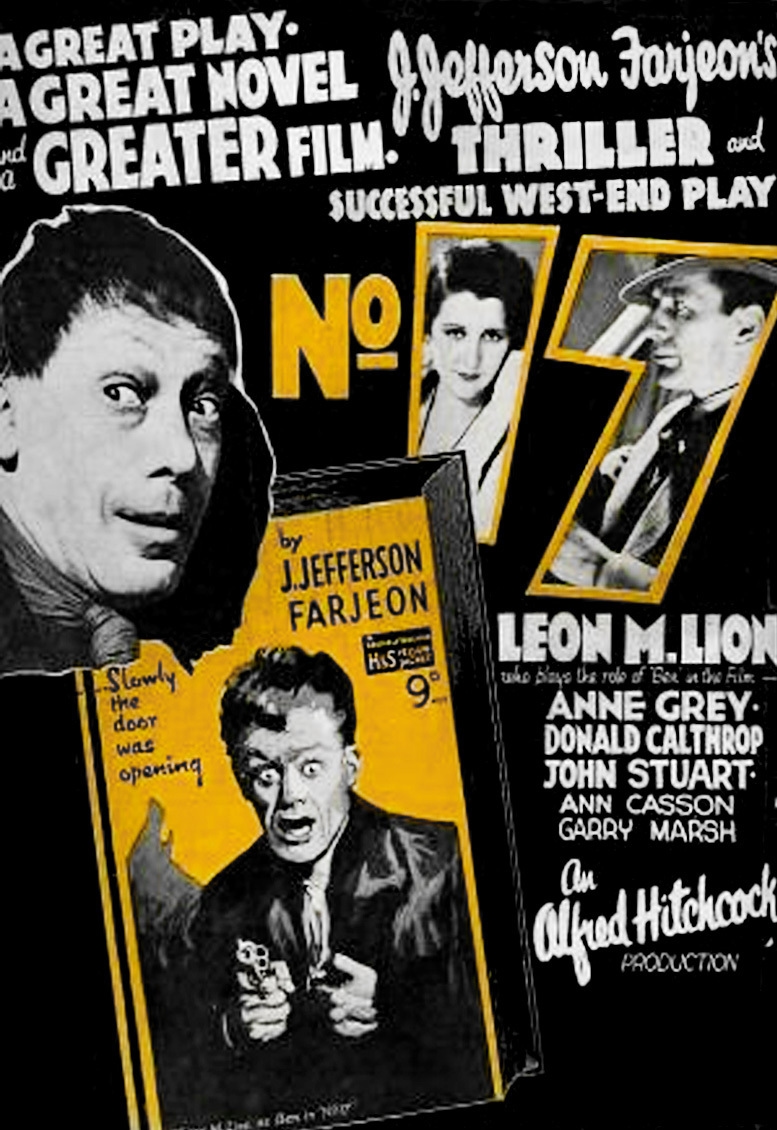
So here’s Number Seventeen, a Hitchcock film that’s almost never mentioned when Hitchcock is up for discussion. “A disaster,” is how the man himself described it, having been forced into directing it by his studio. But then who remembers Rich and Strange (great title) which came before, or Waltzes from Vienna, which came after?
In the silent era Hitchcock had already hit his stride with The Lodger, but when the talkies came in it’s as if he had to re-learn everything. By 1934 and The Man Who Knew Too Much, the process was complete. But here, in 1932, he’s only halfway there.
That said, there’s lots of good stuff here. The opener, for example – a camera following a hat being blown down a road by a gusty wind. The hat belongs to a man, who eventually catches up with it outside a house inside which a candlelight flickers. The door mysteriously opens of its own accord and the man goes in. Inside are a dead man, some handcuffs and a gun, plus a frightened vagrant – “Lumme… it weren’t me, guv,” says cowering Ben.
Why this house, why the dead man, who’s the vagrant and was it him? Hitchcock has set several hares running, and more soon turn up. As the vagrant and the mystery man (John Stuart) – who’s behaving like a cop so might be one – wrangle over the dead man, a pretty young woman comes crashing through the ceiling. “Dad,” she shouts, pronouncing it “Dead” her accent is that far back. This is Rose Ackroyd (Ann Casson), whose father (Henry Caine) is also somewhere in the house. And soon so are more mystery people, including a woman who is deaf and dumb (Anne Grey) and some shady characters with bad hats and criminal moustaches.
The house, it turns out, is well placed for any gang wanting to smuggle jewellery into and out of United Kingdom, which is what’s going on here, though it takes forever for those details to emerge. In the interim, much coming and going in a film that takes place largely on a staircase and a landing, with Ben the piggy-in-the-middle vagrant turning out unexpectedly to be the film’s most important character. Funny and florid, he’s played by Leon M Lion, a stage actor of some note, whose theatricality works better for him than for some of the others.

There is straightforwardly bad acting here, and much ponderous waiting for one actor to finish their line so another can say theirs. It’s awkward and disjointed. Hitchcock stylistically is all over the place too – some expressionism early on, a bit of Eisenstein montage for very little reason – but his manipulation of the restricted frame is inspired and his use of shadow and stark lighting works in the film’s favour. Eventually he takes the action into some shunting yards and onto a train for a tense finale. Hitchcock and trains, a whole subject in itself – The Lady Vanishes, Strangers on a Train, North by Northwest – many PhDs have been written. Though the model work here – those unconvincing locomotives wobbling around on toytown track – is so bad it’s funny.
Hitchcock and sound, not quite there. Hitchcock and tension, also not perfect – some lovely stuff early on with a gun which might or might not be loaded but there’s a later sequence with a collapsing balustrade where Hitchcock fails to make much at all of it. Most odd.
At bottom, Hitchcock is moving fast in an attempt to breathe life into something that’s rather static. It’s the raw materials that are poor. He’s doing a decent job with a story he didn’t reckon could carry a film. He’s right, there really is really nothing there and though the film is short, they’d be a threadbare 65 minutes without Hitchcock behind the camera.
Number Seventeen – Watch it/buy it at Amazon
I am an Amazon affiliate
© Steve Morrissey 2026