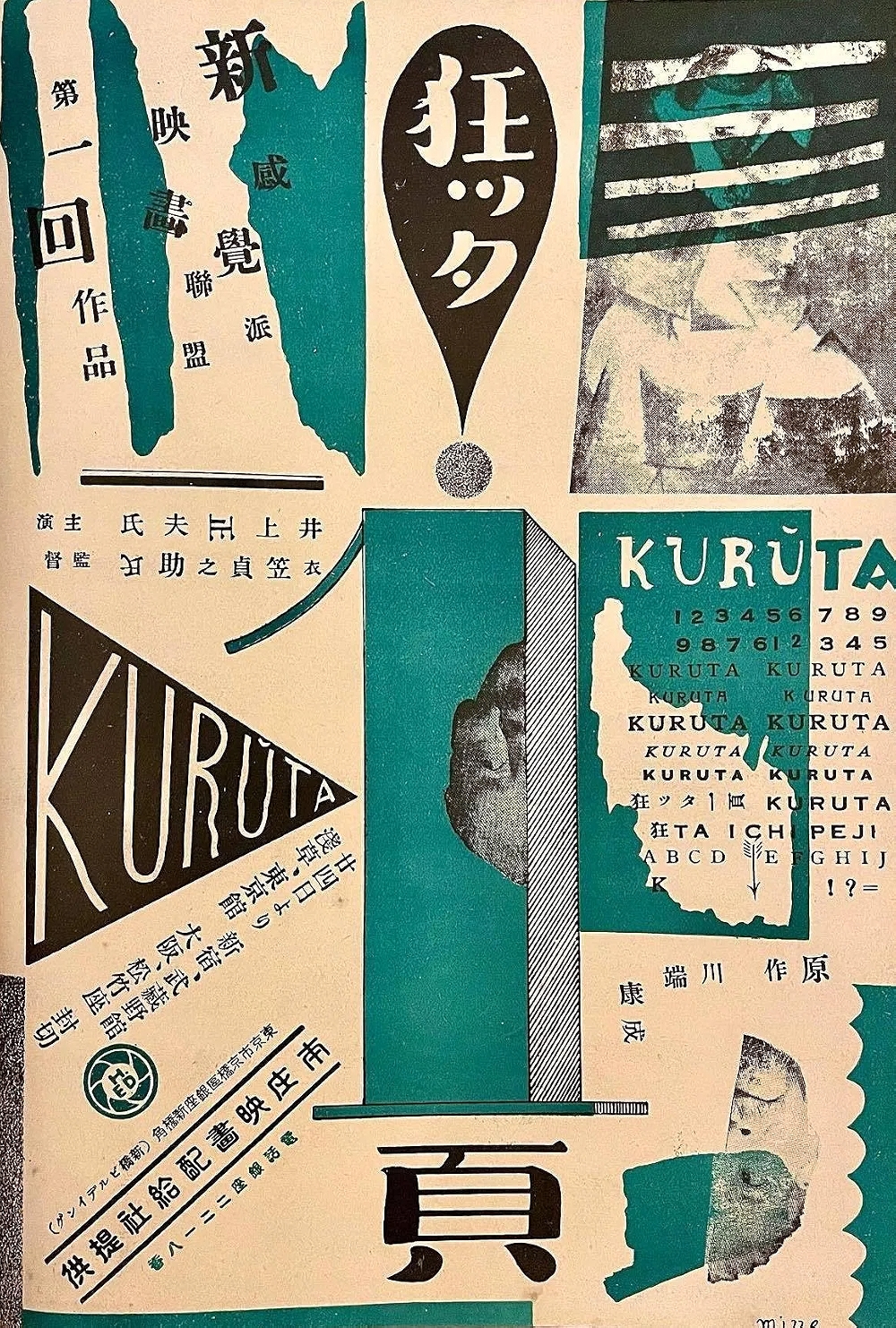
Madness indeed. A Page of Madness was made in 1926 on next to no budget, by a talented director aided by a group of demented avant-garde writers called the Shinkankakuha, who were determined to break free from the shackles of naturalism.
For many years it was considered lost, until its director, Teinosuke Kinugasa, found a copy of the film in a storeroom in 1971. Still with a third of its footage missing, that’s the version you will see today.
The other thing that needs saying before locking in is that it’s made with barely any gear. Kinugasa and co had no equipment to speak of, just a 16mm camera and eight lights. Remember that as you gaze on what this talented gang have made from the most meagre materials.
Using Eisensteinian dynamic collisions and juxtapositions plus expressionist compositions, it tells the story of a woman in an insane asylum and how she got there. But more than that it tells the story of the woman’s husband, how he struggles to hold on to his memories of her as a well woman in happier times.
The opening is particularly vivid – a flashy montage of storm scenes giving way to a dancer in full flight giving way to scenes inside the asylum. Storm plus dancer equals madness, it seems. Giving way yet again to the pitiable woman inside her cell.
Once Kinugasa has laid out his stall, the frenzied mood gives way to something more traditional and measured. Reflecting the fact that the asylum is a place of orderly calm for the most part. The inmates are well cared for by doctors, nurses and orderlies. They get to go outside for fresh air and are well fed.
As time goes by, the rhythms of the place offer up the bones of the story. The man, known only as Servant, has taken a job as a janitor at the asylum to be close to his wife, known only as Servant’s Wife. She, we later learn, is in there because she tried to kill herself and her child.

Using quick cuts, double exposures, repetition, sudden dollies backwards, chiaroscuro lighting, dizzying swings of the camera, overlays, distorting mirrors and with no intertitles to guide us, the film originally came with a spoken narration, now absent. This lack of a steer, plus the missing 20 minutes, means it isn’t always easy to follow. But in fact the “story” is a fairly simple one. It is in any case more a film about mood – sadness, desperation, concern – with sudden outbreaks of turmoil, which Kinugasa is particularly good at capturing.
Eight lights means it’s often moodily underlit. I watched the version with the 2016 soundtrack by the Alloy Orchestra, which is not the one commissioned anew by Kinugasa from Minoru Muraoka. But it is expressive and its semi-ambient synths and traditional Japanese instrumentation help nudge it towards narrative cohesion.
“The phenomenon of perception for Shinkankakuha is, to put it briefly, the direct, intuitive sensation of a subjectivity that peels away the naturalized exterior aspects and leaps into the thing itself,” is how key exponent Riichi Yokomitse described the group’s aims. This film aims visually to catch on celluloid the unmediated directness that was the Shinkankakuha aim.
Technically virtuosic and full of visually remarkable moments, the film is usually described as experimental, but that seems like the wrong word to me. If there was experimentation then it was done before the film was made. Everyone involved here appears to know what they’re doing. Everything is clearly thought through. There is a purpose and an aim, both achieved. A Page of Madness is undeniably unconventional, though. Wouldn’t that be a better way of describing it?
A Page of Madness – Watch it/buy it at Amazon
I am an Amazon affiliate
© Steve Morrissey 2026