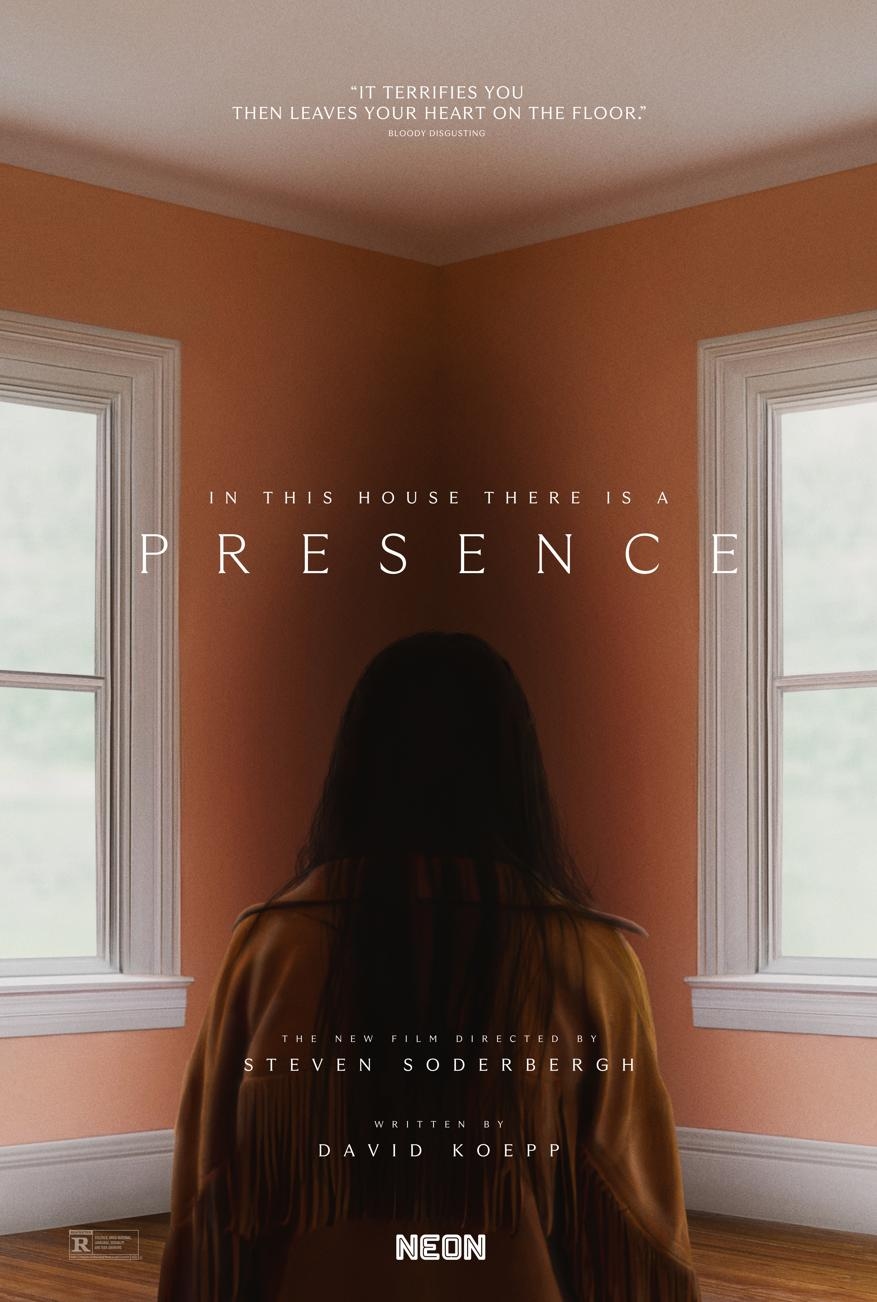
There are big Steven Soderbergh movies and small Steven Soderbergh movies. Presence is the latest of the small ones, stacking up alongside Let Them All Talk and Unsane as another fascinating experiment in Soderbergian minimalism.
Between starry, big-budget affairs like Oceans 11 or Contagion, in his smaller movies this master of technique sets himself film-making challenges, much as Hitchcock did with the likes of Rope or Lifeboat, perhaps also inspired by Lars Von Trier’s concept of “obstructions” (self-installed hurdles designed to jump-start the creative process).
Soderbergh shot Let Them All Talk guerrilla-style, on board a cruise ship while it went about its regular business with paying customers. Quite a feat considering the cast included Meryl Streep. Unsane was filmed on an iPhone.
This time around he’s shooting in one location, on one camera, using the camera as the point-of-view “presence” haunting a lovely old house. What it is, who this thing was we will not find out until the film’s closing moments, when the revelation – you can see it coming if you’re alive to these things (I’m not) – discombobulates a fair bit and recasts much of the film.
Until then a drama, more or less, about the family who have just moved in. The parents, played by Lucy Liu and Chris Sullivan, and the kids, played by Eddy Maday and Callina Liang. Son Tyler is clearly the mother’s favourite. Daughter Chloe is a sensitive child recovering from the recent death of a girl she knew. Of a drug overdose, possibly. This is a family that does not get things entirely out into the open.
If an invisible presence can be said to be a metaphor, then this “presence” is one. A thing lurking and hovering, but usually hiding in corners and wardrobes peeping out at Chloe attempting to put her life back together, while her brother does the hormonally dickish things that teenage boys do. These include inviting his friend Ryan (West Mulholland) over. Ryan is blond, hot and ready for sex. Whether Tyler is acting as a kind of teenage pimp is not entirely clear, but that’s the impression.
The parents, meanwhile, just try to get on with it. Dad Chris accusing wife Rebekah of not being that interested in Chloe. Rebekah responding that what Chloe needs most is time to lick her wounds, not helicopter interventions and a constant re-finessing of her meds. Justifying her lack of interest maybe.

It’s a David Koepp screenplay. When not writing tentpole movies like Jurassic Park or Indiana Jones and the Dial of Destiny, Koepp likes to take on small, intensely psychological projects. Kimi is one of his, so is Black Bag, both high-concept human dramas about interpersonal relations and both directed by Soderbergh.
With the arrival of a psychic informing the family that there is something spooky in the house, things shift into Soderbergh’s favourite decade, the 1940s – composer Zach Ryan’s score has been there all along. This film could not have been made back then though, not with this degree of fluidity at any rate. Soderbergh’s camera scuttles and charges about like a thing that’s scared, observing the action passively, not intervening, not making its presence felt.
With not an awful lot happening, it’s a testament to Soderbergh’s film-making nous and skill that he keeps our interest. Partly just by bravura dramatics – hardly any edits lend it an eavesdropper quality. Partly by tightly wound performances – Liu is particularly good but Liang is the find and she has a magnetic face that holds the attention. Partly the craft of it all. Sharp as a pin throughout and shot on the wide lenses that give it all a dislocated feel.
But also there’s that Friedkin thing. The longer you root a spooky supernatural movie in the real world, the more of a jolt it is when the shouting starts. Soderbergh keeps his powder dry all the way. Presence is not The Exorcist, not by any means, it’s too chilly for that. But it achieves its brutal effectiveness the same way. Wait for it… wait for it…
Presence – Watch it/buy it at Amazon
I am an Amazon affiliate
© Steve Morrissey 2025