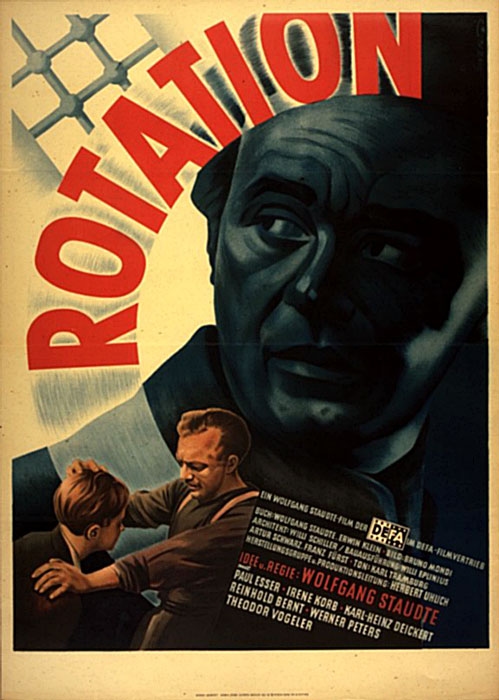
German film-makers of the post-Second World War era weren’t exactly falling over each other examining the country’s recent history. Which makes Rotation special. In episodic scenes it attempts a cool and not-too-political examination of what had possessed Germans to sign up to the Nazi project, and what Hitler had cost them in return.
Significantly, it was made in Communist-controlled East Germany rather than the West. Shot in the DEFA studio, the famous UFA of Lang, Murnau and Wiene rebadged, it was directed by Wolfgang Staudte, who had been responsible for Murderers Among Us (Die Mörder sind unter uns), the first Trümmerfilm (“rubble film”) of the post War era.
If you’ve seen David Lean’s This Happy Breed, about chirpy Londoners heading unwittingly towards the Second World War, Rotation functions as a This Unhappy Breed, telling the story of an average guy in post-First World War Berlin, an everyday Hans (Paul Esser) living through the 1920s and 1930s and on into the calamity of war.
We first meet Hans Behnke falling in love with a young woman, Charlotte (Irene Korb). Hans is struggling to get work in the wrecked economy of the 1920s. Protests on the streets over joblessness are mounting and some people are turning to the easy solutions offered by the Nazis. Neither Hans nor Charlotte are that interested, though. They’re the 1920s version of the Centrist Dad – Hans’s brother-in-law Kurt is a Communist. Hans is on friendly terms with his Jewish neighbours. He talks politics, but only in passing, much as someone discusses the weather.
As time ticks along the Nazis come to power democratically, on an election ticket promising jobs, better housing and a fairer distribution of wealth. In most respects things are as they were before, except Hans has a job, Lotte has a child and the family has an OK-ish place to live. So far the Nazis seem to be delivering.
Then, suddenly, one of Hans’s old friends is starting every encounter with a cheery “Heil Hitler”, and a party official is visiting the Behnke household to ask why there isn’t a picture of the Führer on the wall. Hans works on the presses at the Völkischer Beobachter – the Nazi propaganda newspaper – and is offered a promotion. He is a Party member, isn’t he, Hans’s boss asks him. Hans is not. But he soon is. He has a wife and child to support.

Staudte and his co-writer father Fritz, plus Erwin Klein, deliver an account of politics at a personal level. How “apolitical” decisions made for the good of Hans’s family become in aggregate something more sinister. Though no one used the phrase at the time, Rotation also provides a detailed illustration of the Overton Window – the range of acceptable public discourse – shifting in tiny increments.
Time marches on a bit more. Everyone is suddenly in a uniform. Brother-in-law Kurt is now a wanted man. One day a van draws up and takes the Salomons from upstairs away. Hans’s son Helmuth is now a teenager and a committed member of the Hitler Youth.
All these events, over all these years, done in flashback from the rubble of a Berlin bomb shelter in the dog days of the Second World War. Everyone silent and dejected as the bombs fall.
A character in Hemingway’s The Sun Also Rises is asked how he went bankrupt. “Two ways,” he replies. “Gradually, then suddenly.” The same applies here. The gradually then suddenly-ness of it all is Staudte’s intent. He avoids prolonged finger-wagging. It won’t work with his intended audience. Esser and Korb play everyday wurst-and-sauerkraut Germans, and they do it well, but entertaining, colourful characters swirl around them, like Kurt, a lively, chatty, opinionated man (lovely performance by Reinhold Bernt).
There is drama and intrigue and even a bit of derring-do. Staudte also knows how to stage an action scene. There’s a prolonged section as good as anything out of Hollywood at this time, set in a flooded underground U-Bahn station where everyone is taking refuge from bombs.
It helps that Berlin, especially the Soviet Zone where this was filmed, was still in semi-ruins in 1949. Scenes set on the street have an authenticity even great 21st-century CGI cannot yet buy.
There are small heroics, there is major treachery and not everyone makes it through to the end. There’s even a hint of an optimistic ending, which is possibly a stretch too far.
In the end Rotation is not the place to come for a polemic against the evils of the Nazi regime. It’s too clearly aimed at a German population in the immediate aftermath of a war. Is it a touch too forgiving, too selective in its choice of characters? Undoubtedly. But as a plea for vigilance against the erosion of liberty, democracy, civilisation and decency by a thousand minuscule swipes, it still has plenty to say.
Rotation – Watch it/buy it at Amazon
I am an Amazon affiliate
© Steve Morrissey 2025