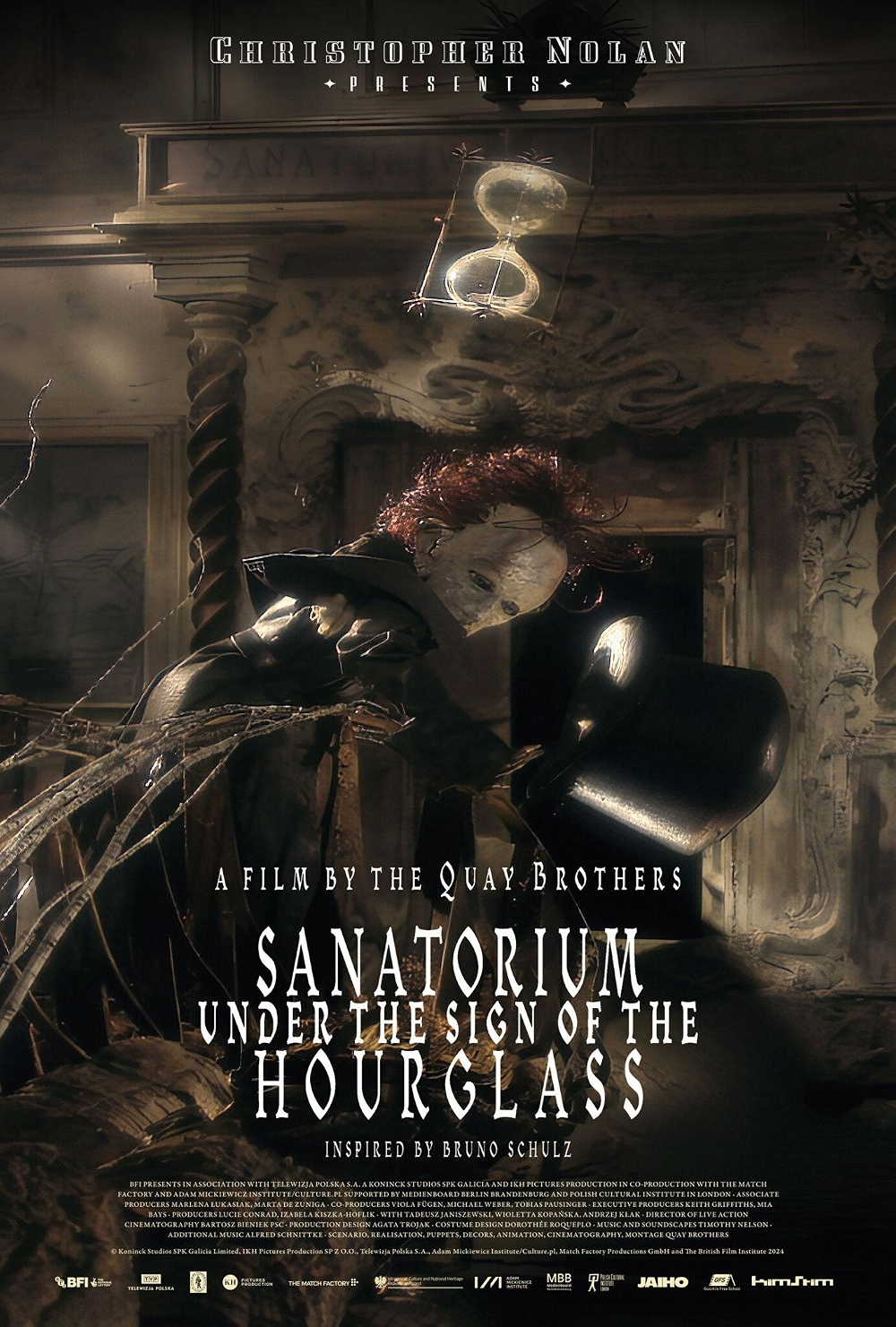
Sanatorium under the Sign of the Hourglass is only the third film the Quay brothers have made in nearly 50 years. There have been a lot of shorts but as for features, apart from this there’s only Institute Benjamenta (1995) and 2005’s The Piano Tuner of Earthquakes, whose whimsy I remember hating. This film not so much – or even not at all. Maybe they’ve changed; maybe I’ve caught up.
No, it’s me, clearly. Their style is instantly recognisable. Americans who live in the UK but work in a resolutely old-school European idiom, the Quays love to mix up animation with live action and work by piling impressions on top of each other, until their effect either convinces (as it did here) or irritates (Earthquakes).
Determinedly non-linear, in black and white, in Polish, with acting that’s the antithesis of naturalistic, featuring a portentous soundtrack and with images that are often defocused or semi-obscured, their Sanatorium is an arthouse phantasmagoria, a dreamy journey into Old Europe, where a box containing a retina has somehow recorded the last images of its deceased owner, which are now being let loose by a white-haired auctioneer (Tadeusz Janiszewski).
The story they tell, these images from a dying man’s failing mind, is jumbled and complex, with time glitches and unsettling resets. It shifts into live action and then back out again into stop-motion animation as it tracks a top-hatted train traveller arriving at a sanatorium where his father has recently died. When he gets there he’s told that in this realm – live action? or is something else meant? – the old man is not yet dead. (Though any hope that this means a shift to a more coherent storytelling style must be parked.)

The Quays then assault us with the grandly gothic and the nightmarish, as if Edgar Allen Poe had rewritten Alice in Wonderland and included vampires in his retelling. There are shades of Czech maestro Jan Svankmajer in the Quays’ jerky stop-motion imagery constructed, it seems, from battered Victorian materials and figures. The effect is oppressive, like a narcotic, or waking from a bad dream to find you’re in Castle Dracula rather than at home in bed.
Rational continuity is at a premium. Perspectives shift. The image becomes opaque or soapy soft. Sometimes it flips or is veiled, or twisted. Time runs backwards and forwards. Repeats. In slo-mo.
Lovers of German expressionism from the Weimar era will be most open to this approach. As will fans of Bruno Schulz’s original, very Kafkaesque novel from 1937, or Wojciech Has’s 1973 movie version of it, The Hourglass Sanatorium (“only marginally exasperating” – the New York Times) which also tracks a man’s visit to a sanatorium where time is misbehaving.
This cabinet of curiosities will not be for everyone, in other words. The Quays have been working on it since they wrapped on Earthquakes a couple of decades ago. It is a labour of love, and clearly intended as art rather than commerce. The “Christopher Nolan Presents” tag on Amazon is a clear attempt to open it up to a wider demographic but it could be categorised as misselling. Buy Nolan get Quay – there will be complaints.
Though what Nolan and the Quays produce are flagrantly at odds with each other, for what it’s worth, Nolan is a genuine fan. His first film, Following, had something of the Quay nightmarishness about it, and his 2015 documentary about the twin brothers, Quay, proves he’s willing to put his money where his endorsement is. That said, what the crossover area would look like between Nolan and Quay fans on a Venn Diagram I do not know, but I doubt it’s much.
Sanatorium under the Sign of the Hourglass – Watch it/buy it at Amazon
I am an Amazon affiliate
© Steve Morrissey 2026