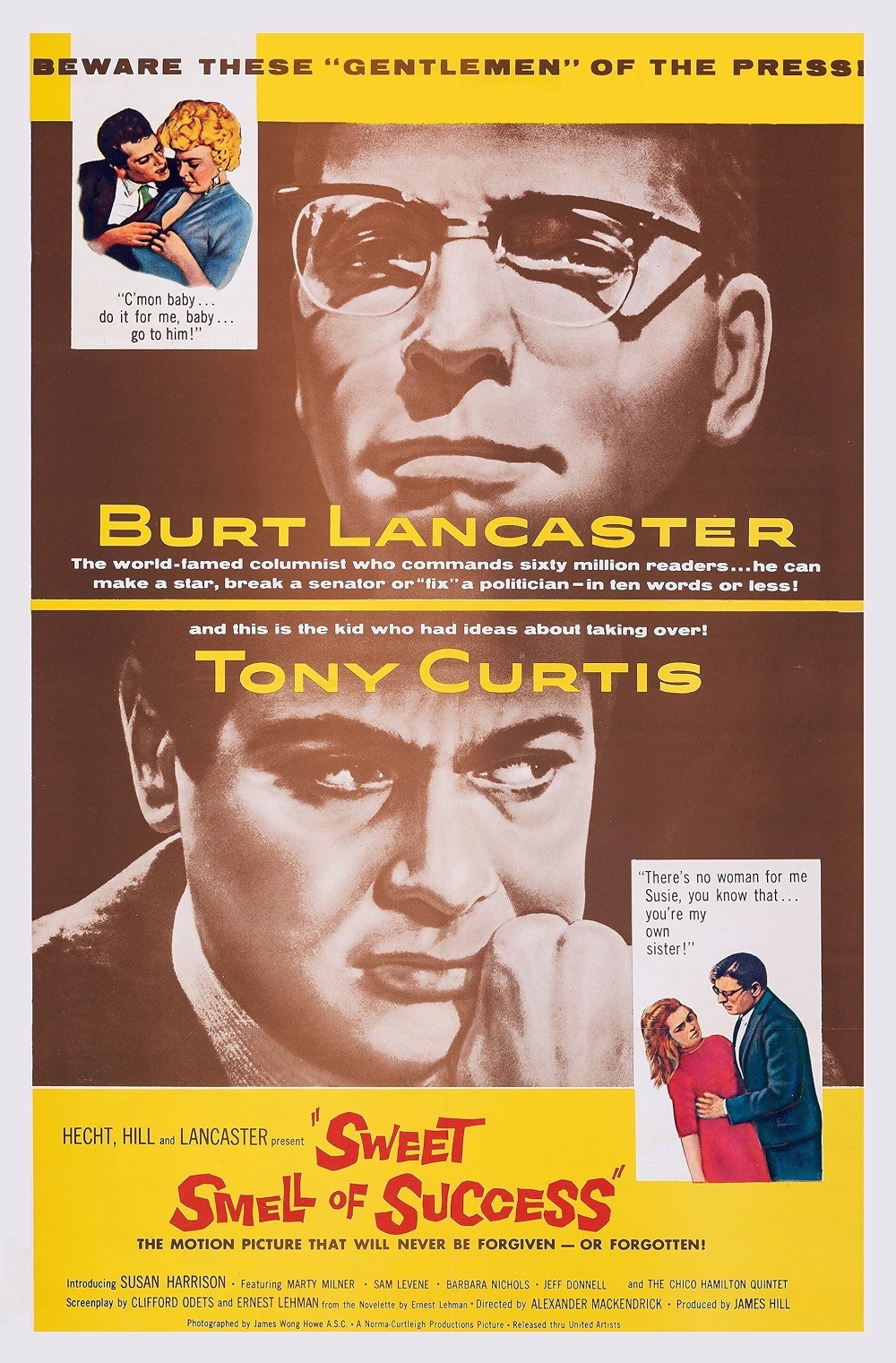
Sweet Smell of Success flopped at the box office on its debut in 1957, much as its producer, Burt Lancaster, feared it might. A dirty-underbelly-of-showbiz tale, like Sunset Blvd. and In a Lonely Place, it’s been redeemed by posterity, which often marks it as one of the finest noirs ever made, even though it doesn’t tick all the genre boxes.
One reason for the failure was the casting of its star. Not top-billed Lancaster, who put his name at the head of the credits not just out of ego, but also to deflect attention from the real star. Tony Curtis was best known at this point for playing a series of pretty boys and was not obvious for his role. As a bit of rebranding it turned out to be one of the most decisively successful ones of all time – at a stroke Curtis was no longer simply a light romantic lead who looked good in swimwear. But did it help the film?
He plays Sidney Falco, a New York agent with a significant side hustle feeding stories to a twisted and probably closeted columnist whose snide showbiz column mixing gossip, reviews and breaking stories has put him at the top of his game. Whether JJ Hunsecker is based on journalist Walter Winchell or Irving Hoffman (writer Ernest Lehman worked for him) doesn’t matter too much because this is essentially Sidney’s story, a discomfiting one about a schlemiel finally running out of road.
Lehman’s screenplay introduces both men in decisive swipes – Sidney like a courtier attendant on Hunsecker, who’s not taking his calls, and JJ palling about with everyone from politicians to street cops, anyone who can give him a story.
The reason why Hunsecker is not taking Sidney’s calls is because Sidney has, so far, failed to drive a wedge between Hunsecker’s sister Susan (Susan Harrison) and her jazz-musician boyfriend Steve (Martin Milner). JJ does not approve of the relationship. There is probably nobody who would be good enough for Susan, in JJ’s estimation. His feelings for his sister are, Lancaster’s playing suggests, unwholesome.
It’s not much of a plot but it’s enough to spin this web of short scenes together, in which we see each man operating in his different milieu. Sidney is the bottom feeder, while JJ skims off the top. Yet both men essentially work the same way, by turns solicitous and duplicitous, bending their behaviour this way and that depending on whether they’re offering favours or begging them out of people.

Harrison and Milner are bland and they’re meant to be. The action is with Curtis (on screen almost all the time) and Lancaster (acid-drop appearances here and there) and the men behind the camera. Alexander Mackendrick, who’d learnt economical shooting working on small budgets at Ealing Studios, preferring to do it in-camera rather than at the edit suite if he can. James Wong Howe, shooting the night-time New York streets in a stylised chiaroscuro, swinging his camera through many crowded smoky rooms. Elmer Bernstein and his big brassy score. Noir, it says, though there isn’t a noirish femme fatale to speak of – Susan is a victim and the other women in it aren’t on screen for long enough.
Lancaster’s performance is one of persistent threat. He had, to use Elmer Bernstein’s description, a “short fuse” in real life, and that’s how Hunsecker comes across too. Curtis sweats in all the colours of the rainbow as a persistently craven man who inhabits a “moral twilight”, as Hunsecker’s describes him. Pot kettle.
Is Hunsecker gay? It’s often suggested he is, though the uncertainty of anyone’s standing in this film is more about morality than sexuality. Only Susan and Steve are truly on the level, and they’re dramatic non-entities.
Steve is meant to be a guitarist in Chico Hamilton’s band and that is Chico and his guys playing behind him. All part of the “keeping it real” vibe producer Lancaster, director Mackendrick and co were all tapping into with all that shooting on the mean streets of New York. At one point we see JJ leaving his apartment block. It seems he lives in the Brill Building, where, in 1957, Burt Bacharach and Hal David also wrote their breakthrough hit Magic Moments for Perry Como. Think on that while watching this descent into the moral abyss. The vibe could not be more different.
Sweet Smell of Success – Watch it/buy it at Amazon
I am an Amazon affiliate
© Steve Morrissey 2025