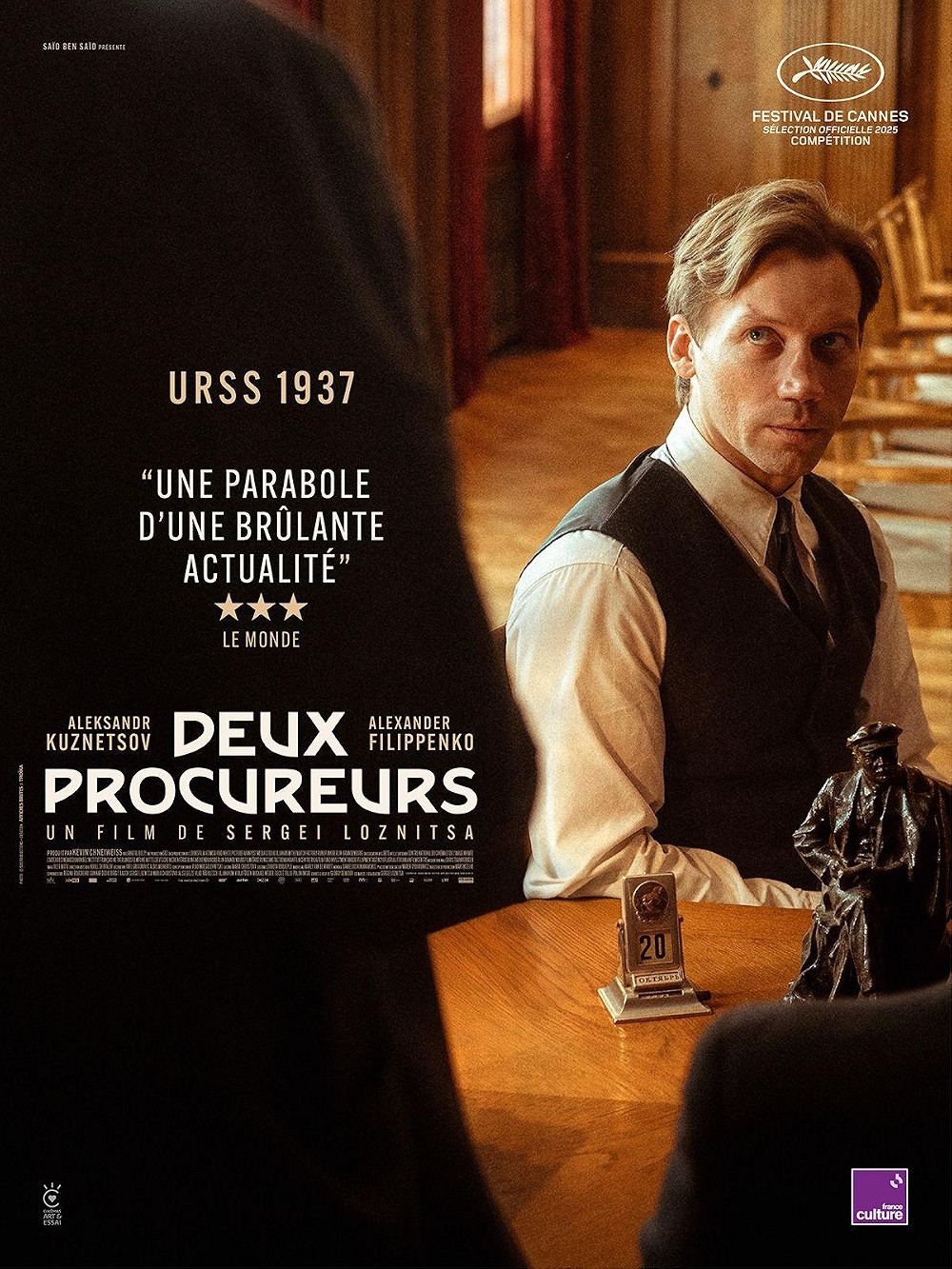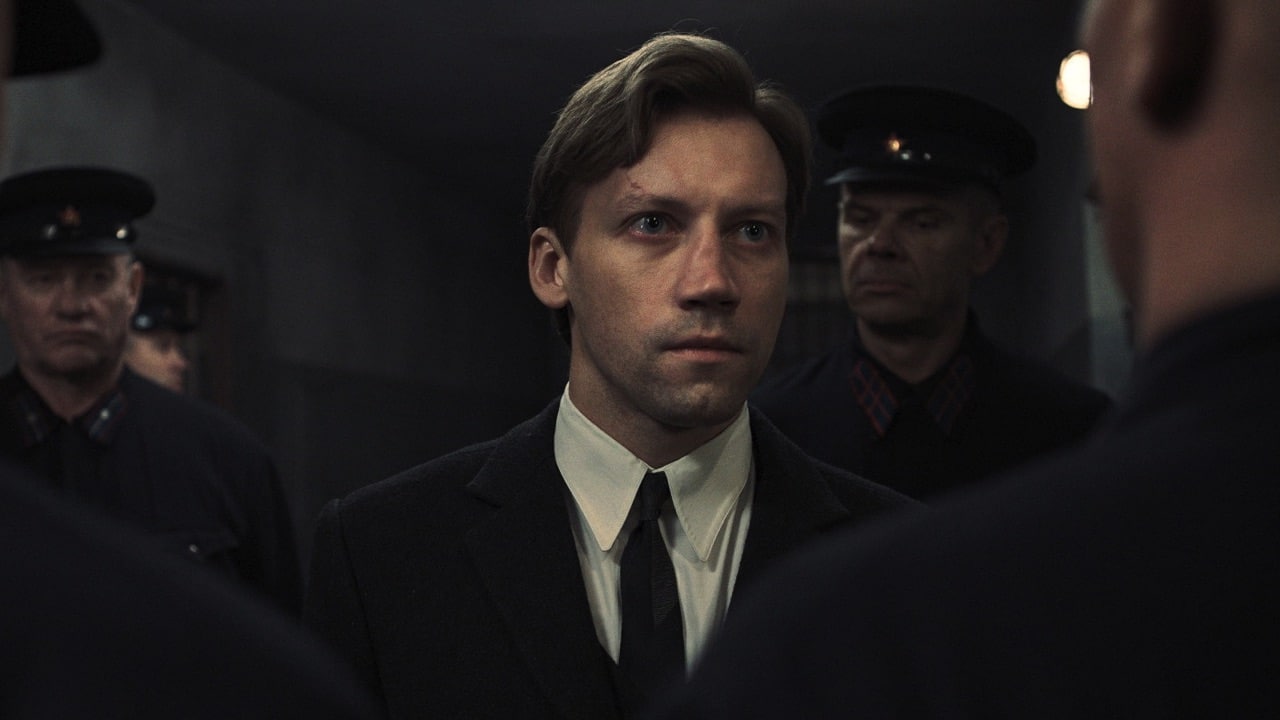
What happens when a state goes mad and its leader starts to behave like a king, ruling by whim? Two Prosecutors (aka Zwei Staatsanwälte) is asking that big question right from its opening frame, in which state prosecutor Kornev (Alexander Kuznetsov) arrives at a 1930s Soviet gulag and asks to see a prisoner. Other countries/regimes are also available.
As the film goes on we’ll learn something about Kornev but Ukrainian writer/director Sergei Loznitsa, working off Georgi Demidov’s novel, holds back vital information and to an extent leaves us in the dark about him and about what’s going on. Two Prosecutors, the title says. Here’s Kornev, he’s one, but who’s the other one? All is, I think, revealed, in a payoff that is the slowest of slow burns, a grim-sting finale that colours the whole film an unwholesome shade of comic black.
This is a film about the double consciousness necessary to survive in a regime that’s gone wrong, where purges are common, paranoia is rife and the government appears to be ruling by vendetta. Kornev, with his cards close to his chest the entire time, appears to be a straight arrow, a prosecutor who is trying to represent a prisoner, insisting that the letter of the law be adhered to, because no one can be found guilty of sticking strictly to the law, right?
Kuznetsov, he of the extravagantly broken nose, you might know from the brilliantly brutal comedy actioner Why Don’t You Just Die! He really shows how good an actor he is here, suggesting hinterlands of emotion with almost no change of facial expression as the idealistic young prosecutor everyone in the gulag – prisoners, guards – is suspicious about. Because there’s nothing more dangerous than someone who doesn’t know how to play the game. But is Kornev playing a game, like everyone else is? Or is he really as he appears to be, just trying to ensure that his client, mistrustful Stepniak, is being treated fairly and being given at least the bare legal necessities?
In the central dramatic interview scene, the gnarled, tortured Stepniak – played in masterly fashion by the cusping-80-years-old Aleksandr Filippenko – tries to set Kornev straight about the nature of his crimes and by extension the nature of the regime. He’s in prison, he says, because he refuses to deviate from the original ideals of the revolution and the party is now going to work executing people like him because they are an embarrassment.
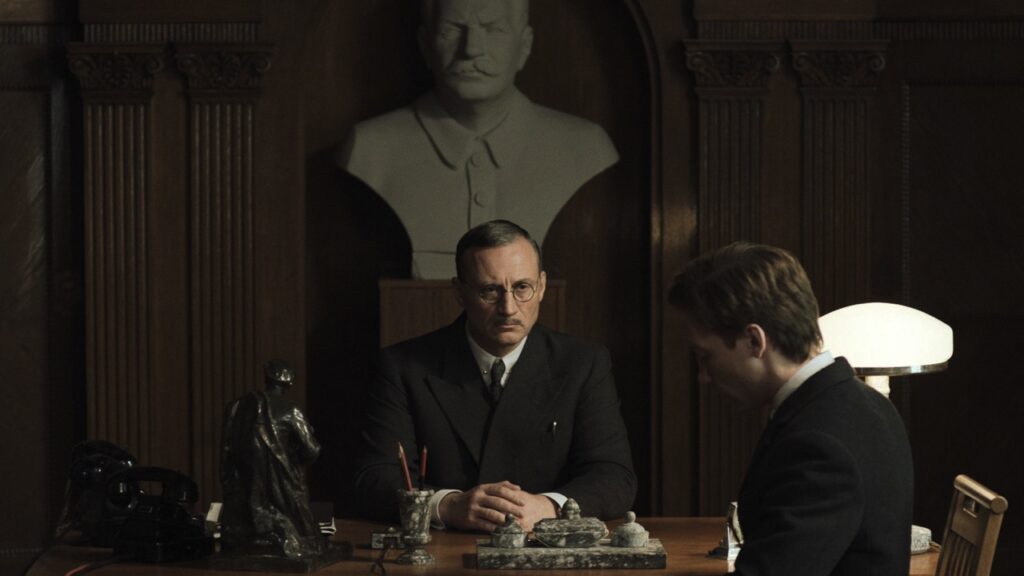
Loznitsa gives it the full Kafka-esque treatment. This is a prison of dark, desaturated colours, plenty of corridors. Everyone moves as if there were all the time in the world, because there is no urgency to anything. Here, process and bureaucracy flatten human experience. Not a lot happens, because it’s the nature of the regime to give people the runaround. Kornev spends a lot of time waiting to see people, trying to find the right office to fill in the right form. Doors. Waiting rooms. Corridors.
Kornev appears to be a man labouring under a massive delusion – that the brutality and illegality of the regime is a bug and not a feature. If only Stalin knew how things were being run, his attitude seems to be saying, surely the injustices would stop. Or is he using this apparently naive world view as a stratagem?
This is a film that’s all set up and a very sudden pay-off. Its ending operates in much the same way that the secret police do, arriving unannounced when least expected. It needs to be watched in much the same way that everyone in it behaves, with one ear for what’s being said and another for what’s being meant. The film, you might not be surprised to hear, was not released theatrically in Russia and remains unavailable on streaming platforms there.
Two Prosecutors – Watch it/buy it at Amazon
I am an Amazon affiliate
© Steve Morrissey 2026