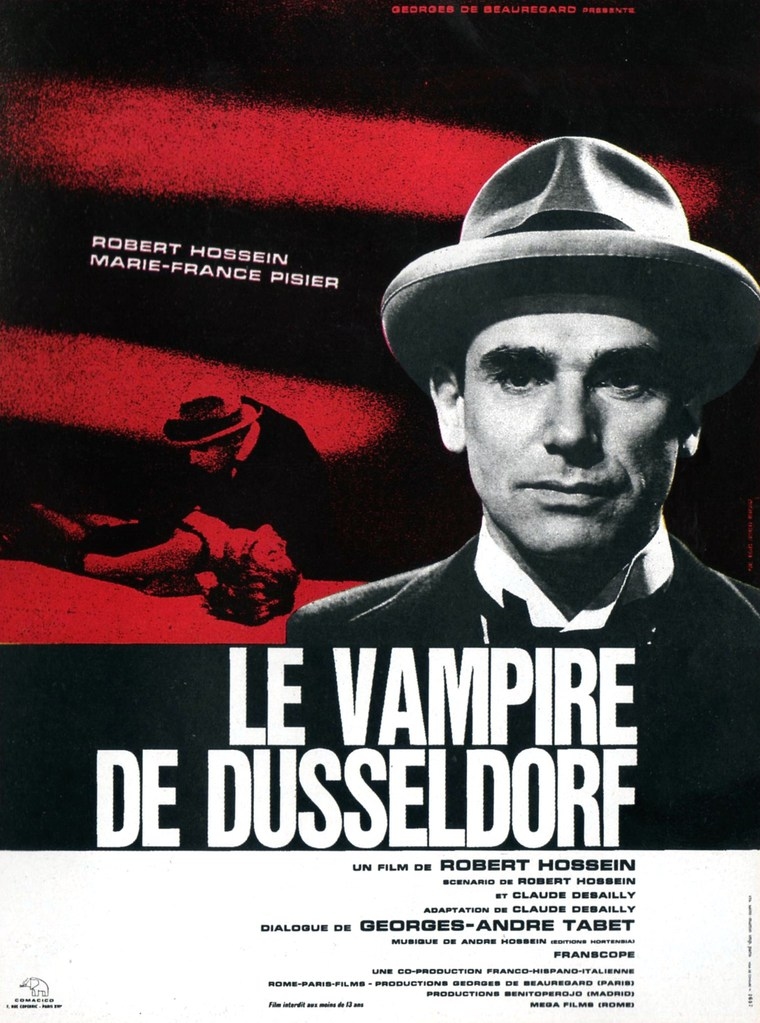
A weirdly lugubrious serial-killer movie, 1965’s Le Vampire de Düsseldorf tells the story of Peter Kürten, a real-life killer who operated in the Düsseldorf area in the late 1920s before being caught, tried and executed in 1931.
Look him up in Wikipedia, if have the stomach for it, and you’ll realise that director/writer/star Robert Hossein has left most of the gruesomeness out of the picture. Kürten tended to kill his female victims with a pair of scissors. Hossein leaves that in. The rest of it, the sexual kick Kürten got from watching women in their death throes, he only suggests. Better that way.
Hossein finesses Kürten’s timeline a touch, to make him align more neatly with the rise of the Nazis. The metaphorical intention is clear, if a touch heavy-handed, though there are some cute plot pivot points, like when Hitler’s Mein Kampf becomes a factor in Kürten’s downfall.
But for the most part it’s a fairly standard serial-killer story. The impassive loner who seeks out single women to murder, and writes taunting letters to the police, but has a strange fixation on one woman who might well be his salvation.
Anna (Marie-France Pisier), the cabaret artist, is an interesting creation midway between Marlene Dietrich and Liza Minnelli’s Sally Bowles: the husky singer in top hat and bustier with a come-hither look that attracts Peter. What she sees in this mournful, saucer-eyed individual is not at all clear. And his intentions towards her remain hidden too. Is he courting her to kill her at a much later date, the elaborate process an aberrant form of foreplay?
Hossein’s playing of the character is similarly distant. A little boy walk. A deferential posture. Face a mask. There are occasional suggestions that he’s aiming for Peter Lorre in Fritz Lang’s M, bolstered by the stark cinematography of Alain Levent, a name associated with the French New Wave, though Hossein is not making a New Wave film here.

Best known as an actor – memorably in Rififi – in fact Hossein directed quite a bit. Here he’s about ten years into a career that produced a version of Les Misérables (1982), Cyrano de Bergerac (1990) and Ben Hur (2006), none of them the definitive one. Hossein kept working right to the end, dying aged 93 in 2020.
What he’s up to here remains a slight mystery. It’s not exactly a portrait of a serial killer, there’s not quite enough detail for that. Neither is it a rounded picture of a society terrorised by a serial killer’s reign of terror. Nor is it an out-and-out horror film splashing about happily in victims’ blood.
The character of Peter is closed off. Courteous to his neighbours, distant from his fellow workers, he likes Wagner and has a single outfit of smart clothes at home, which he changes into before setting off for the club where Anna sings. At one point, he takes her off for a day in the country where, in an unguarded moment, he tells her something about his childhood and the film screeches to a bizarre early climax.
The Nazis, meanwhile, wheel about, beating up Communists on the street, setting fire to bookshops, the allegorical Peter in social form.
The score, by Hossein’s father, André, nails the mood. It’s woebegone, as is this film. Nothing heroic to see here. Hossein keeps us at arm’s length from his killer, as if he’s worried that we’ll come to like him. I wondered while watching it if Fatih Akin had taken inspiration from it to make The Golden Glove (Der Goldene Handschuh). A film that goes full tilt in the other direction, it forces us to identify with real-life serial killer Fritz Honka and then taunts us with our own bloodlust.
Le Vampire de Düsseldorf and Der Goldene Handschuh. now there’s an interesting double-bill.
Le Vampire de Düsseldorf – Watch it/buy it at Amazon
I am an Amazon affiliate
© Steve Morrissey 2025