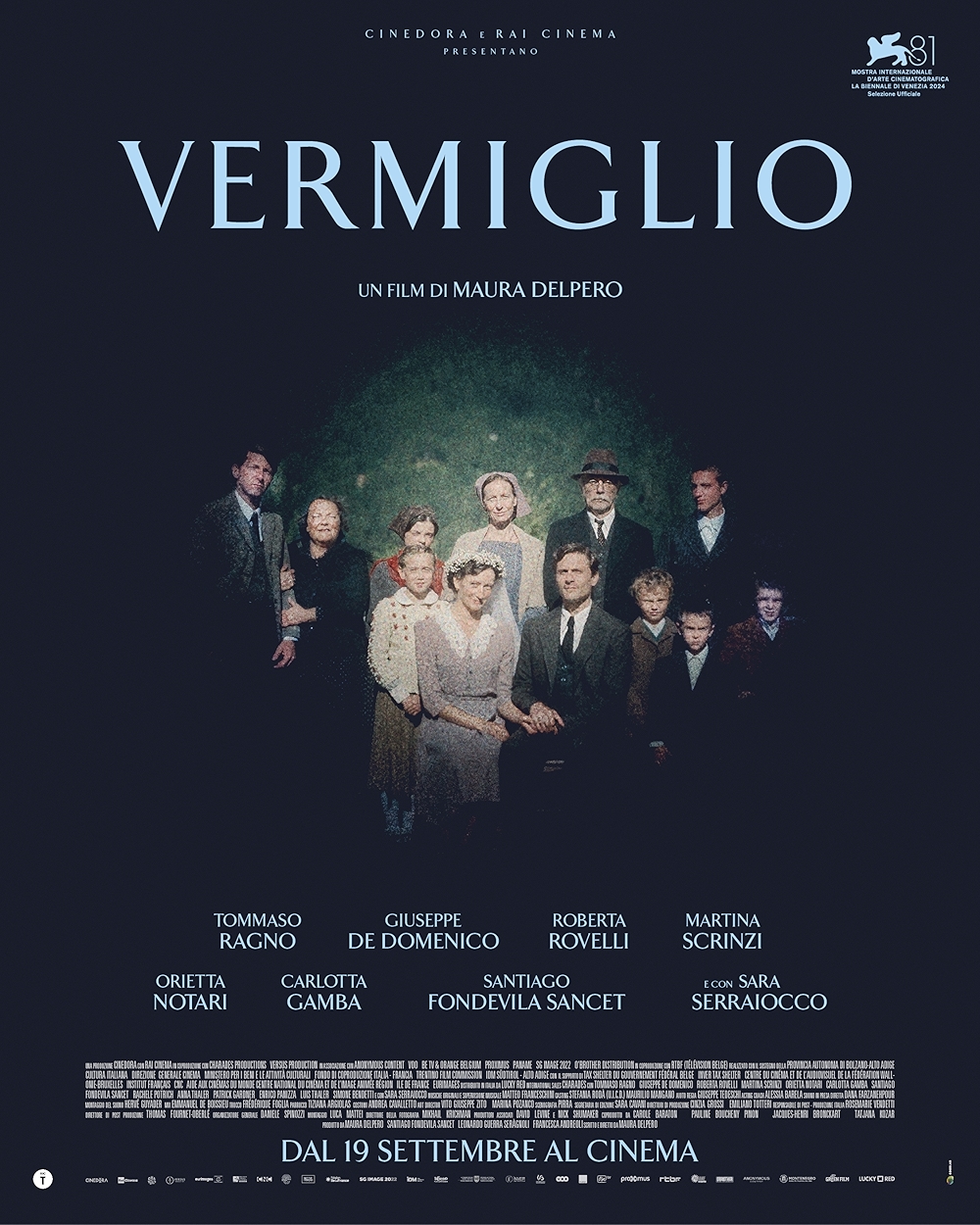
Done a bit faster and with less attention to detail, Vermiglio would be a soap opera. Its story is pure soap – secret assignation, love, betrayal, jealousy, closely guarded secrets and the warm embrace/stultifying smother of the family environment.
Maura Delpero’s film is set in northern Italy in 1944 where a deserter from the army – sensing war is over – is hiding out with a large family up in their barn on the hill. He falls for one of the daughters, and she for him, and in the natural scheme of things they get close. Then… disaster. And spoilers.
Pietro (Giuseppe De Domenico), a dark and handsome Sicilian, woos Lucia (Martina Scrinzi), though he can barely speak her dialect of Italian and cannot read or write. He decides to take lessons with Lucia’s father, Cesare (Tommaso Ragno), the local teacher who presides over the school in the same way he presides over his family, with a patriarchal but not despotic iron rule.
Meanwhile, Cesare’s wife Adele (Roberta Rovelli) is still pumping out the babies. Cesare is a randy old goat and the family is Catholic and so this will continue until she is no longer able to, a new baby replacing the one we see dying early on. Ada (Rachele Potrich), Lucia’s younger sister, is possibly a lesbian but certainly more interested in girls than boys, particularly livewire Virginia (Carlotta Gamba) who lives down the road. Flavia (Anna Thaler) is the smart and vocal much younger sister who is soon going to outgrow the sort of teaching she can get from Cesare. Dino (Patrick Gardner), the sullen and entirely unbookish son who’s clearly a disappointment to his father, who does nothing to hide it. And Zia (Orietta Notari), an aunt who is the family’s conscience and moral arbiter, her judgments based on the way things have always been done, and what people will think of her and the family.

Delpero has said that the film is based on her father, though not on his life exactly, more on the sort of lives that men from his era lived. Poor and austere but hopeful for the future. A life constrained by circumstance and the time and place you were born, though all this is beginning to change.
Education is one of the vehicles of change, plus motorised transport, the miss migrations of wartime, the gradual breaking down of borders, physical and metaphorical, as the modern age sweeps the last rural pockets of old Europe away.
The cast is superb, an ensemble almost unlike any other, the performances so good that you feel these are real people whose lives you’re watching. Delpero’s camera helps – slow and patient, with lighting so subtle there might not be any and cinematography by Mikhail Krichman (who did similar great things for Andrey Zvyagintsev in a string of brilliant films including The Return, Elena, Leviathan and Loveless) which does not overegg the picture-postcard beauty of the setting, saving its wows for the interiors – churches, living rooms, a convent hospital, the schoolhouse.
The total effect is not unlike an update on Ermanno Olmi’s The Tree of Wooden Clogs, which presented life in rural Italy at the end of the 19th century as, in effect, a continuation of feudal life. Here, the cracks are visible. The structure is not going to hold much longer. In the personal dramas, particularly of the three sisters (who share a bed), the future is taking shape.
Elegant and calm, in spite of the roiling passions it portrays, it feels like it could go on for ever. Like a soap. And yet, when Delpero brings down the curtain at the end, it feels entirely right, the story has been told. This is her debut fiction movie after a couple of documentaries. Way to go.
Vermiglio – Watch it/buy it at Amazon
I am an Amazon affiliate
© Steve Morrissey 2025