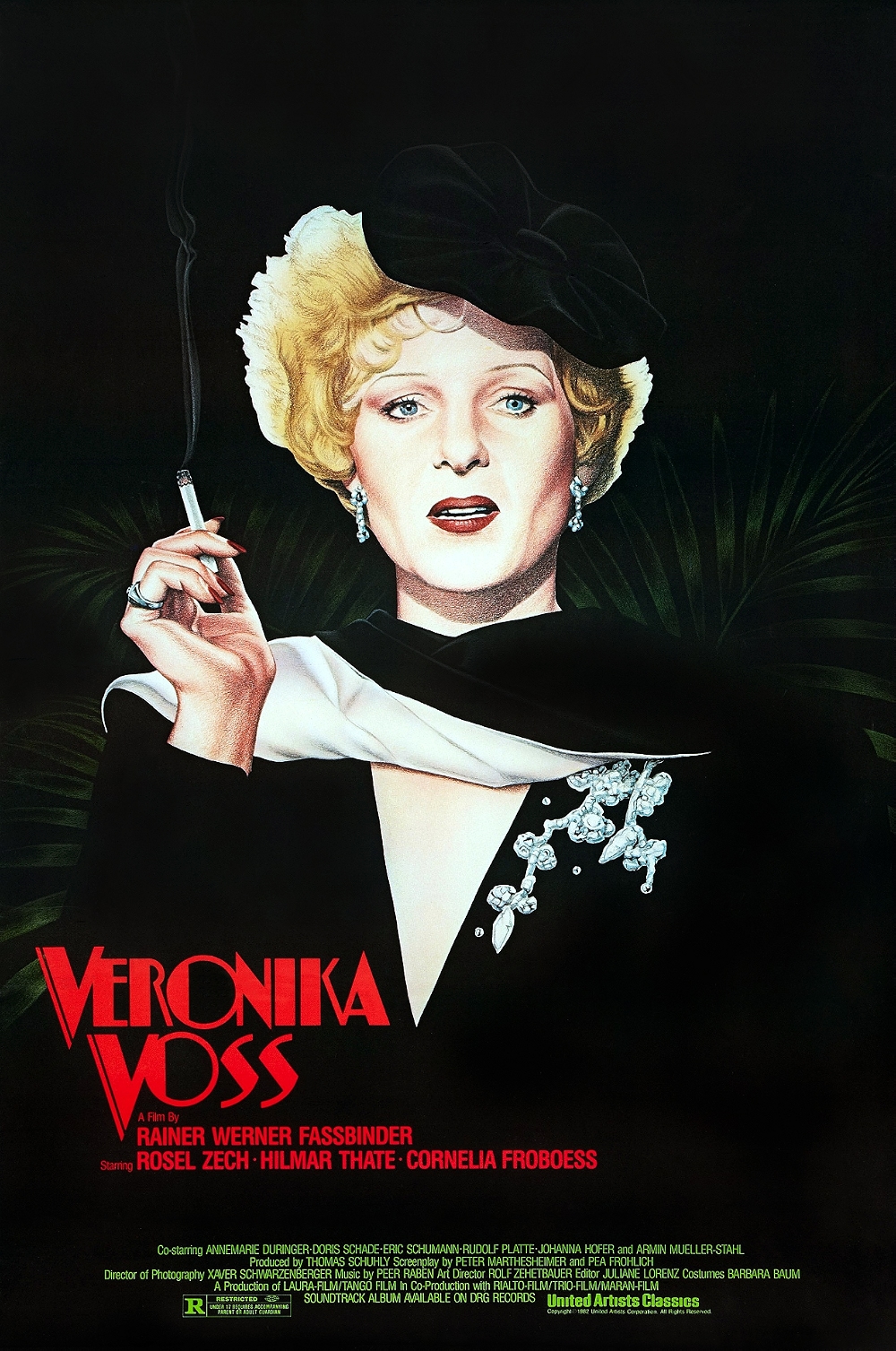
By a stretch the best of Rainer Werner Fassbinder’s so-called BRD Trilogy, Veronika Voss stands out against The Marriage of Maria Braun and Lola because Fassbinder had the great good sense to co-opt Billy Wilder’s brilliant Sunset Boulevard to help with the telling of the story of an ageing German actress and the young man who befriends her in the 1950s, much as he borrowed Von Sternberg’s The Blue Angel with Lola.
Rosel Zech plays Voss, a once-shining, now-diminished star who is lent an umbrella in a downpour by a young sports journalist (Hilmar Thate). He has no idea who she is, but, with a journalist’s nose for winkling out a story, works out that this woman’s “it’s the pictures that got small” routine indicates she’s something in that area. Fascinated, he plays along with her diva act and a strange, asymmetric relationship develops, between Veronika and journo Robert, and eventually also with Robert’s girlfriend, Henriette (Cornelia Froboess), who comes out a long way third best when Robert and Veronika embark on an affair.
In flashbacks to the Second World War we meet Veronika’s doomed husband, Max (Armin Mueller-Stahl), and in sideways dives we learn from overheard gossip that Veronika is said to have slept with Josef Goebbels.
Veronika is also a morphine addict being supplied by a society doctor who uses the drugs to keep a hold on her. The drugs are a metaphor for fame but they do double duty, acting also as a metaphor for the Nazi ideology that Fassbinder was convinced modern West Germany couldn’t quite free itself of.
Voss is based on the actress Sybille Schmitz, who rode the Nazi train up and eventually down again in the interests of furthering her career. Schmitz’s story is every bit as tragic as Voss’s – if you want to see how good she was then look up Dreyer’s Vampyr, made in 1932, before Schmitz had yoked herself to the Nazi wagon.
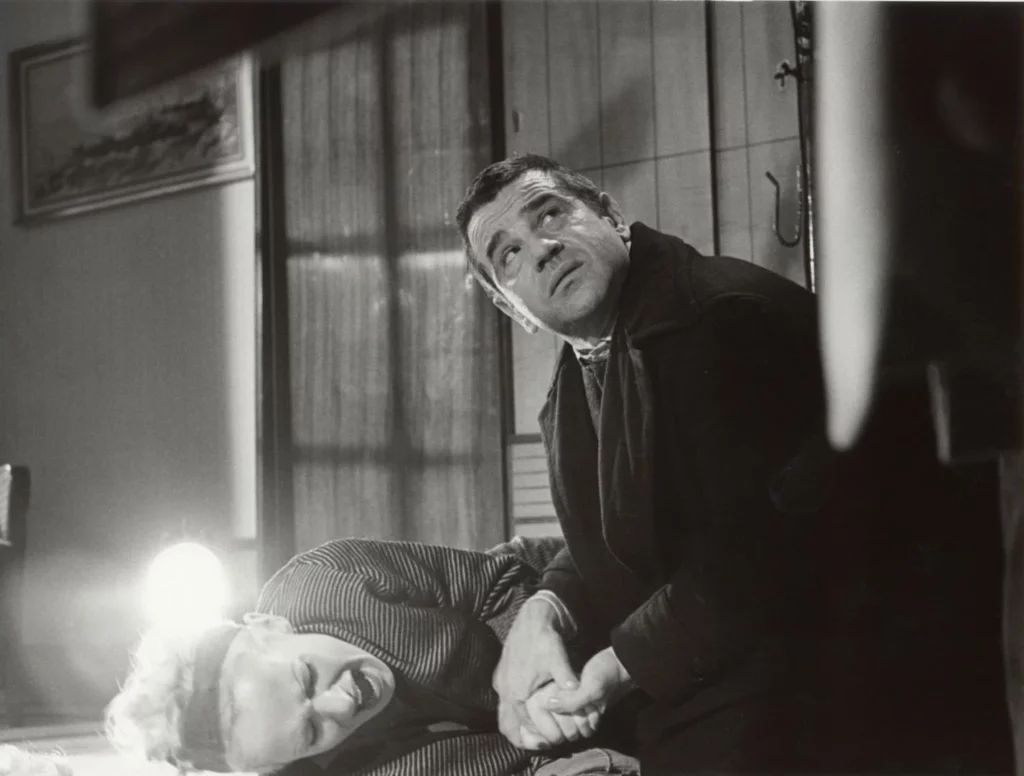
Shooting in black and white, Fassbinder uses light – and the colours black and white – in a highly dramatic way. There are bold sweeps of light, pools of light, light shone straight into the lens. Rain comes lashing out of the sky, water runs down windows. For his flashbacks scenes Fassbinder puts starburst filters on his lenses, to suggest that the past is literally blinding, or that the people back then were blind, take your pick.
Fassbinder’s film-making is self-conscious and postmodern, with wipes, iris shots and dissolves calling attention to surface technique, but the film-maker wins out over the cultural theoretician (as it did in Fassbinder’s best films) in many scenes, like the one in a nightclub where Voss sings a highly ironic Memories Are Made of This in the Dietrich style while Fassbinder’s camera sweeps about taking in the characters in the club, all of them dubious.
Paradoxically, considering how keen Fassbinder was to rake over Nazi coals no one else wanted raking over, he has quite a bit of sympathy for Zelch, and by extension Schmitz, much as Billy Wilder did for silly Norma Desmond, and by extension Gloria Swanson. In both (or all four) cases we get a portrait of a wreck of a woman whose neuroticism used to be protected by the shield of fame. Without it the former stars are lost.
Performances, film-making technique, a story that works at a superficial level but with wider resonances, there’s so much that’s great in Veronika Voss that it’s worth watching several times. Is it Fassbinder’s best film? With a back catalogue of over 40, of which I’ve seen maybe ten, that’s impossible to say, but if nothing else it sets a very high bar.
Veronika Voss as part of the BRD Trilogy – Watch it/buy it at Amazon
I am an Amazon affiliate
© Steve Morrissey 2024