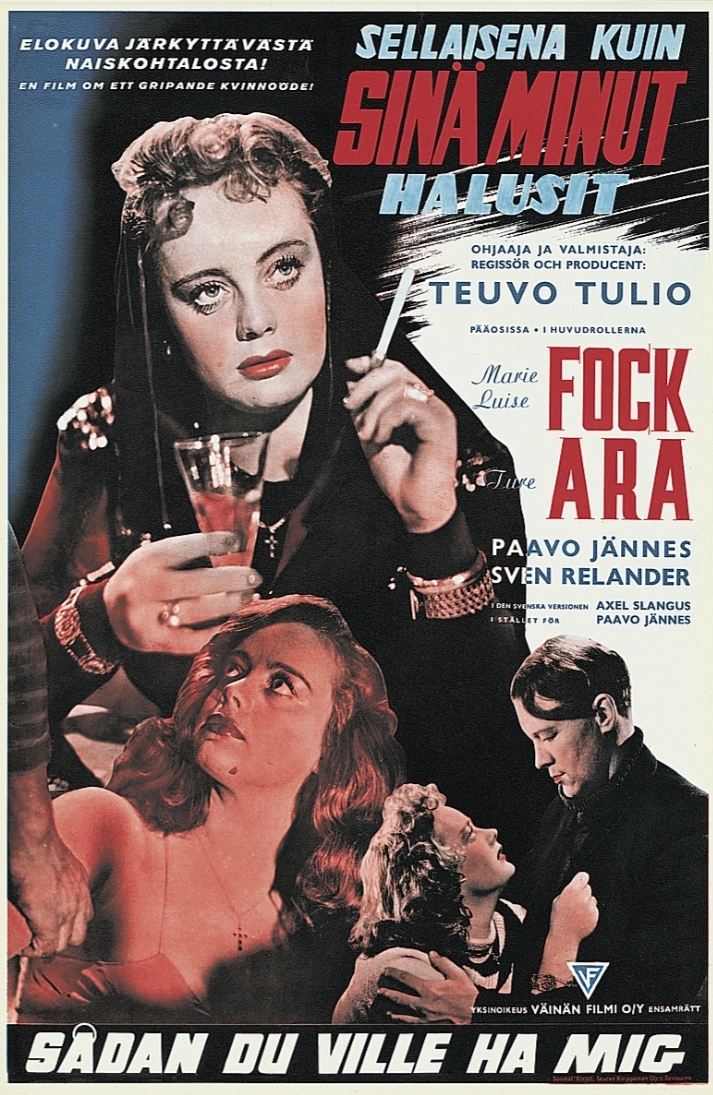
Something of an outsider, an unknown quantity even by the standards of old cinema from far-flung corners of Europe, Teuvo Tulio is quite a maverick and The Way You Wanted Me (Sellaisena kuin sinä minut halusit, in the original Finnish) is a great example of what he does. A stark and direct melodrama, it’s a noir-meets-Douglas Sirk story of a sweet country lass corrupted by big-city morality and then tormented by fate, which repeatedly holds up a chance of redemption only to snatch it away again.
Pushkin’s The Postmaster seems to provide the bare bones of the plot, and though Tulio has changed a lot of the particulars, certain key scenes map pretty well on to the original story of a young woman going to the big city in search of one sort of love, only to find another sort when she gets there.
Young Finn Maija (Marie-Louise Fock), “the most beautiful girl in the archipelago”, has her heart broken when the young villager she has set her heart on, Aarne (Ture Ara), refuses to stand up to his father and declare that she’s his girl – an old feud between the families or something. Perhaps to get her own back, she immediately heads off to the big city with another suitor, the slippery Erkki (Kunto Karapää), where her gradual descent begins.
We know from the opening shot – Maija working as an addled prostitute servicing whichever sailor will pay her – that the degradation will eventually be total. But Tulio is more interested in Maija’s moral rather than physical decline as bad luck robs her of any chance of happiness. Men come and go. The bad ones are after only the one thing – see Erkki. The good ones are whisked away by cruel fate. One is on the point of making an honest woman of Maija when he’s arrested for spying!
Eventually, Aarne returns to the story, and fate offers Maija a second chance of happiness. By this point it seems clear that it’s unlikely to come her way.
“I was weaker than my destiny,” Maija says at one point, in a film unafraid to put into its characters’ mouths exactly what they’re thinking. Unambiguous speech is matched by unambiguous lighting. Teuvo frequently lights only the speaker in a scene, leaving the rest of the actors in shadow. It’s brutal, but honest to an extent.

This is a film that’s composed like a series of storyboards barely come to life, as a series of tableaux vivants. Lit like stills, Teuvo’s images are static and heavily composed, with Teuvo throwing in some Eisensteinian juxtaposition to suggest a dynamism that isn’t there.
If all this suggests simplicity, that’s not quite the case. Teuvo’s characters are more complex than they appear. Take the scene where the mother (Annie Sundman) arrives in the city to save her daughter from ignominy, only to find that Henrik (Paavo Jännes), Maija’s current sugar daddy, is a man of means. One cup of very good coffee later and the mother is won over – everyone has their price, and maybe Maija was primed to fail in lessons learned at her mother’s knee.
It’s the melodrama of it all that some find hard to handle. Fock’s performance is very good. Expressive, dramatic and a bit unhinged, it’s symptomatic of the entire film, which jumps from one lip-quivering moment to the next.
Redemption is dramatic, though, Teuvo seems to be saying, and eventually he pushes all the levers to the max by invoking the celestial – Maija’s daughter Karin in church on her knees, her proud father one one side, her mother (who gave Karin away to save her) cowering at the back and watching her incognito. Teuvo flashes to an image of Christ in Gethsemane.
What are we to make of Maija’s repeated stumbles throughout the film? She falls only to get up again. Is she Jesus and her life is her Stations of the Cross? If so, it’s even more melodramatic than even Douglas Sirk ever managed. And that’s saying something.
The Way You Wanted Me (as part of a Teuvo Tulio box set) – Watch it/buy it at Amazon
I am an Amazon affiliate
© Steve Morrissey 2026