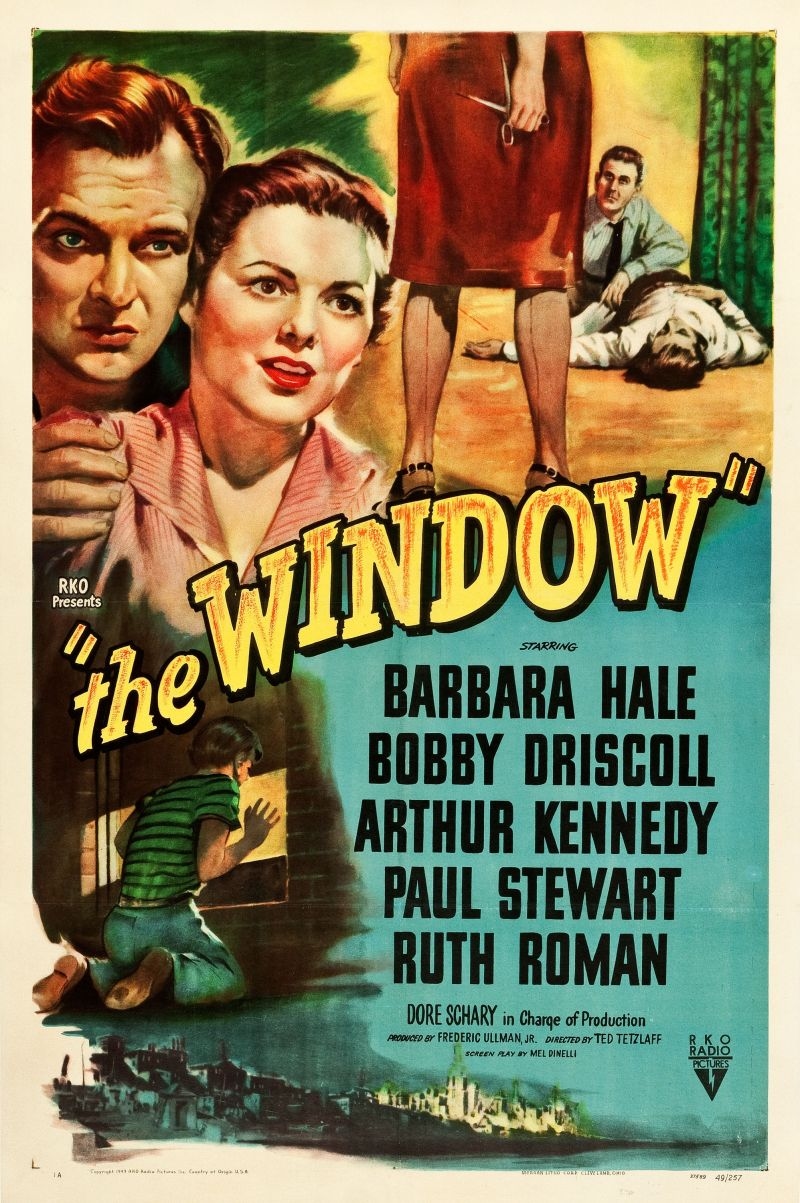
If you like Rear Window you might like The Window, a thriller from 1949 running on the same fuel – impotent voyeurism.
Both films are based on short stories by Cornell Woolrich. This one from a “boy who cried wolf” tale called The Boy Who Cried Murder, about a doughty kid who, on a hot summer’s night goes out onto the fire escape of his parents’ New York apartment to sleep, and while out there sees his neighbours killing someone. Tommy (Bobby Driscoll) is a bit of a loner who makes up stories to fill the gaps where friends should be, so when he tells his parents (Barbara Hale, Arthur Kennedy) what he saw, they don’t believe him. So he goes to the police station, where they don’t believe him either. But they do half-heartedly send a cop over to check out the neighbours. The cop finds nothing, because he didn’t really look. It might have ended there if Tommy’s mother hadn’t stirred things up by taking Tommy upstairs to apologise to the Kellersons for telling tall tales about them. Now they know why they got that visit from the boys in blue and they also know that Tommy knows what they have done…
Young Bobby Driscoll won a Juvenile Oscar for his performance, entirely deserved for this “confronting the Kellersons” scene alone. But there is a lot of good acting in this movie. Hale and Kennedy as the hard-working average Americans, she all motherly concern, he regularly flying off the handle at his son and clearly worried his boy is going to grow up weird. Hale would later make over 300 appearances as Perry Mason’s right hand woman Della Street and is as competent and sweet here. Kennedy was later a favourite of Arthur Miller – and there as here masculinity in crisis is what Kennedy is delivering, with just a hint of Broadway in his performance.
Upstairs, at the Kellersons, Paul Stewart and Ruth Roman are both fantastically shifty as the killers. Anthony Ross as the detective who makes the initial, desultory investigation comes into his own later on.

In the literature, much is made of this movie’s “shot on the mean streets of New York” credentials but really it’s just a few establishing shots. For the most part it plays out on a couple of interior sets. There is more than a hint of the New York stage about the whole thing.
But it works as a movie because Driscoll makes such a plausible frightened kid and Woolrich’s story doesn’t need a big arena. In fact it benefits from the confined spaces as it moves him, in little increments, into increasingly isolated positions. Eventually Tommy is left all alone when his parents go out at night, allowing the Kellersons to move in and save their skins by removing him from the equation.
Plausibility is its currency – yes, you might crawl out onto a fire escape on a hot summer’s night and, while there, you might overhear or see something you shouldn’t. Yes, if you were a kid who cried wolf, it’s likely your parents wouldn’t believe you, and also, because you’re a kid, that the cops might not be interested either. And if you were a killer couple and a kid had found out what you’d done, then killing him would make some sense.
All this goodwill is slightly thrown away with a plot twist that comes quite late on, which saves Tommy from the fate obviously coming his way.
Ted Tetzlaff directs in a deliberate documentary style, adding to the sense of realism, saving much of the film noir lighting and the dramatics for the finale, which is genuinely thrilling. Suddenly the theatrical staging is replaced by genuine movie stuff – stunts, elaborate set design and the like. It’s not Hitchcock, maybe, but this finale isn’t a long way off.
The Window – Watch it/buy it at Amazon
I am an Amazon affiliate
© Steve Morrissey 2026