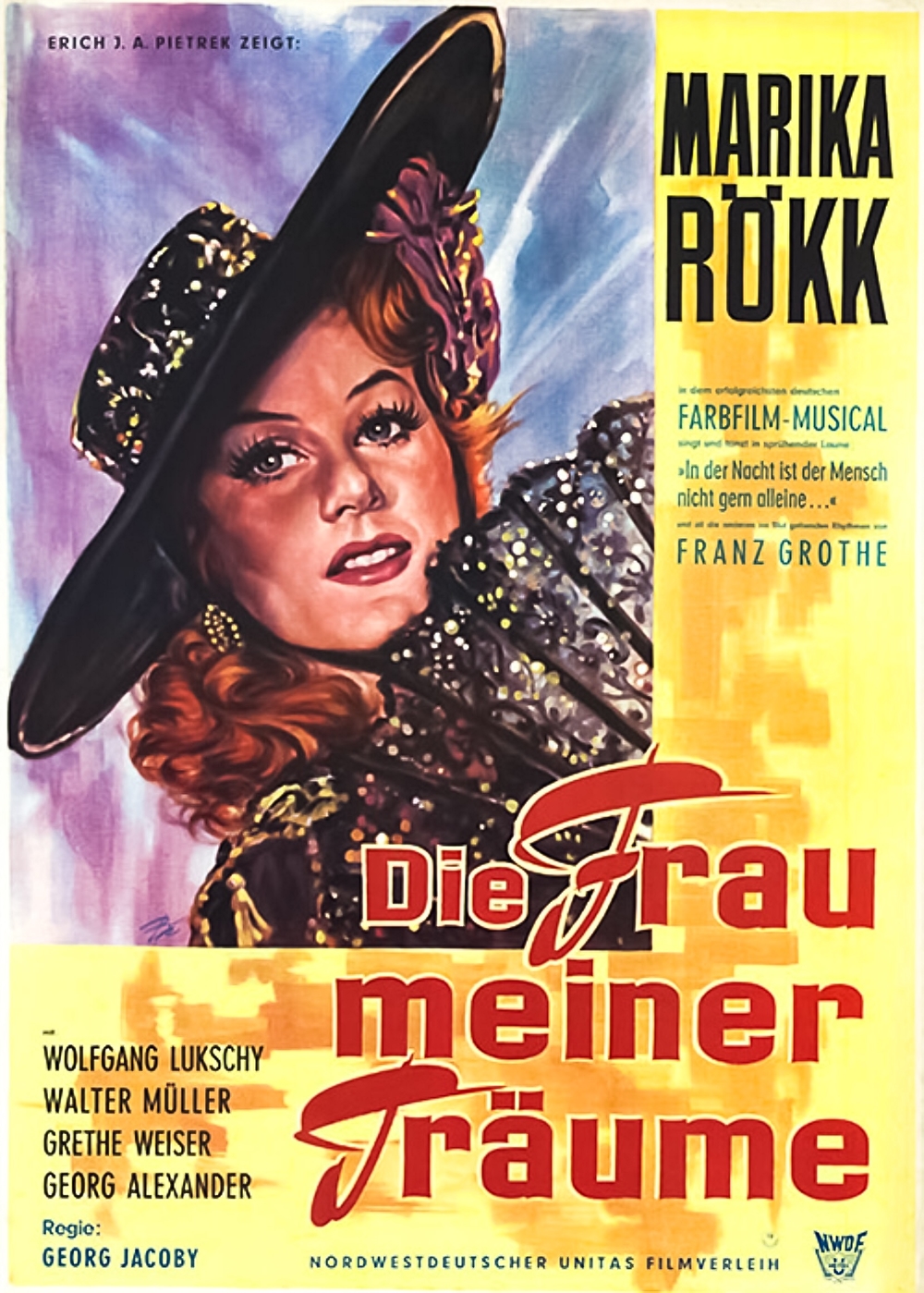
Die Frau meiner Träume (The Woman of My Dreams) was just what the doctor ordered in 1944, if the doctor in question was Goebbels and you were a happy member of Germany’s Thousand Year Reich. Light, frothy entertainment in the Hollywood style was what propaganda chief Goebbels had commanded Germany’s UFA studio to make and that’s what this is.
It couldn’t have come at a better time. On the day it opened, 25 August 1944, the Allies were in the process of liberating Paris, the Warsaw Uprising was underway and the Germans were being rapidly pushed back out of the USSR.
But never mind all that, here’s Marika Rökk to keep spirits high with a lively story about a famous star of the musicals who gets sick of it all and runs away to the mountains, where she falls in with two engineers and discovers the simple joys of hearth and home.
The hausfrau subtext is as near as the film comes to being ideological, and there’s no sign of Nazi regalia, or even of soldiers. It’s as if the country isn’t on a war footing at all.
Rökk had been groomed by Goebbels to be a homegrown equivalent of a Hollywood star. Born in Cairo to Hungarian parents, she’d worked in Paris, on Broadway, made her first film in the UK, but became a star in Germany during wartime. This is her career high point.
She’s energetic and coquettish and gets a saucy, Dietrich-style song in her opening number. She sings, she dances, though no one ever manhandled Dietrich (imagine it) the way Rökk is thrown around as she runs through various dance styles until eventually the number finales with a cancan routine that’s a match for anything out of Hollywood.
It’s somewhat atypical. Most of the film takes place in the mountains (the studio), where Julia (Rökk) meets engineers Erwin (Walter Müller) and Peter (Wolfgang Lukschy) after getting stuck in the snow in the middle of nowhere. They are there as part of a team blasting tunnels for a new railway track and take her in and look after her, unaware of who she is.

An opera-style comedy of mistaken identity and misunderstanding plays out, with a love subplot about Erwin throwing himself at Julia, who isn’t interested, while Peter hangs back disdainfully, leading to the eventual inevitable. Things are much as they might have been if this were a Fred Astaire and Ginger Rogers film, though there’s no dancing (until the final number back in Berlin) and really only one song.
Julia’s character, wilful, scheming, self-important, isn’t entirely nice and it’s easy not to be entirely taken with Rökk’s playing. But you cannot deny her energy. The important bits are the opening and closing numbers and the song at a tavern about halfway through. The rest of it, which is Julia, Erwin and Peter in a threeway tangle, can be fast-forwarded through at “nothing to see here” speed.
The production designer is Erich Kettelhut, who’d done Metropolis for Fritz Lang and he earns his Reichsmarks in those extended opening and closing numbers, which are lavish and gorgeous, beautifully designed and photographed. The Agfa film it’s shot on isn’t exactly Technicolor but it’s rich and warm enough. Director Georg Jacoby (who’d later marry Rökk) knows how to direct a musical number.
Like a good Preston Sturges, Frank Capra or Ernst Lubitsch film, it’s packed with really good support players – Grethe Weiser as Julia’s endlessly talking maid, and Georg Alexander as the theatre director she is stuck with as the two of them look for the missing Julia.
Its message that the simple things are the important things may have a distinctly Germanic inflection (Julia dons a dirndl, at one point, to signify her transformation) but is just the sort of thing you’d find in a Hollywood film by Sturges, Capra or Lubitsch.
Escapism, pure and simple, for a country that needed it, though Julia ends up back in Berlin in another stage show, so she doesn’t quite get the victory she was after. But then, out in the real world, neither did the Germans.
Die Frau meiner Träume – Watch it/buy it at Amazon
I am an Amazon affiliate
© Steve Morrissey 2025