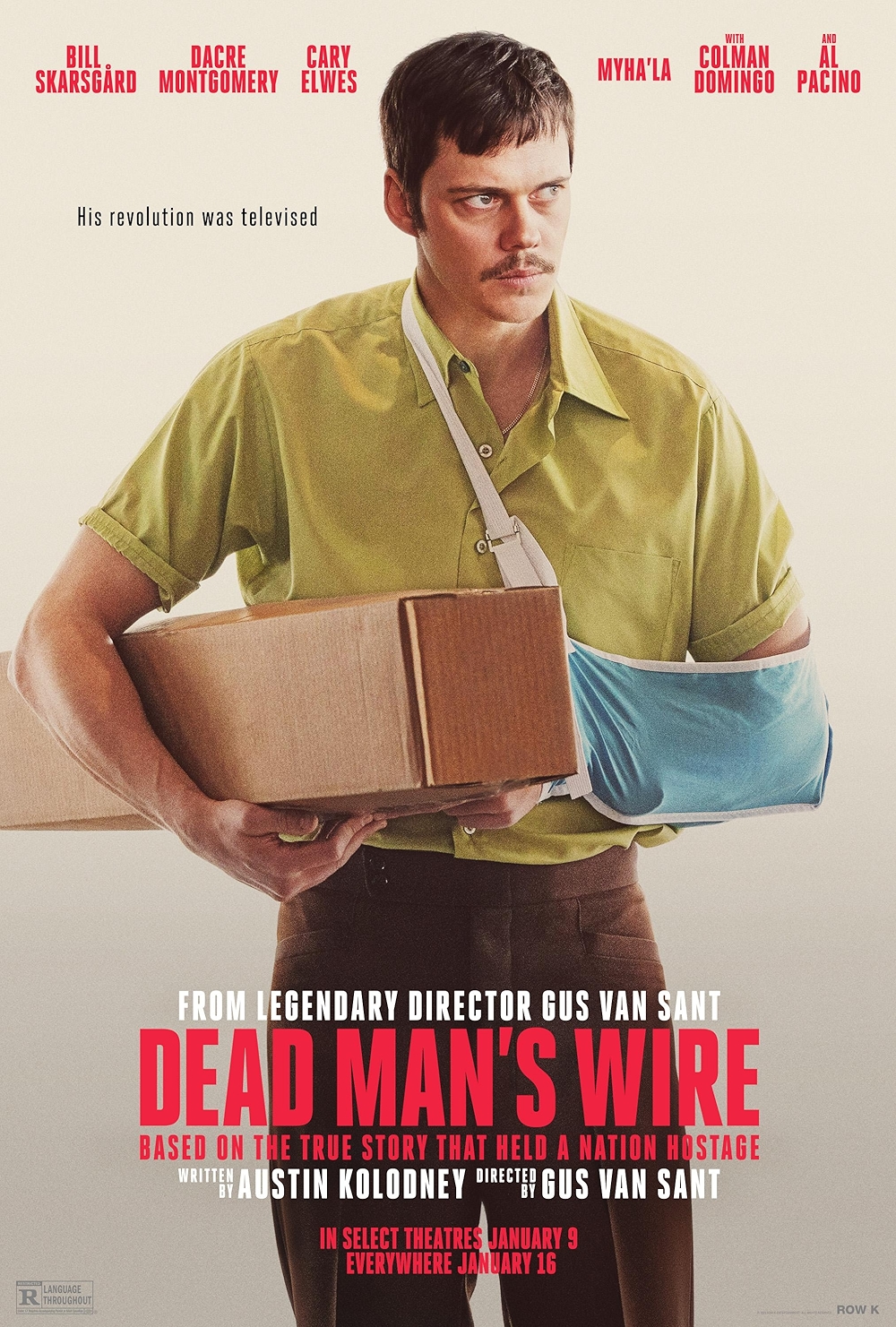
In 1977 Tony Kiritsis walked into a loan company in Indianapolis and took mortgage broker Richard Hall hostage. With a gun to his hostage’s head, and a wire connecting Hall’s neck to the trigger, Kiritsis had the broker where he wanted: any interference and Kiritsis would pull the trigger; should Hall make a sudden movement, then the “dead man’s wire” would activate the trigger. The police, who were soon on the scene, were helpless.
Kiritsis had a beef with the company, which he claimed had lent him a lot of money to develop a shopping mall and then engineered things so the project would fail. In the process Kiritsis had gone bust and, clearly, also gone mad.
Dead Man’s Wire builds on Dead Man’s Line, a 2018 documentary by Alan Berry and Mark Enochs, which dug into old archive footage and interviewed witnesses. Originally Werner Herzog was meant to direct this dramatisation, with Nicolas Cage as Kiritsis, but in the end it’s Gus Van Sant calling the shots with Bill Skarsgård as the desperate Kiritsis.
Who knows what Herzog and Cage would have done with it, but Van Sant and Skarsgård have pulled together a tense and intense drama, clearly modelled on Dog Day Afternoon, with Van Sant putting sun in the lens and deploying the zoom madly to get the 1970s look just so. Al Pacino even gets to appear, as Hall’s hard-nosed father, a man who seems willing to sacrifice his son rather than give an inch in negotiations – money, but most of all a public apology is what Kiritsis is after.
Skarsgård’s jangly and unsettling performance removes him entirely from the shadow of brother Alexander and dad Stellan (other acting Skarsgårds are also available). He’s really a thing of wonder here, though in fact all the performances are excellent. Dacre Montgomery as poor Richard Hall, Colman Domingo as laid-back Fred Temple, the groovy DJ on local FM radio Kiritsis increasingly sees as a guru/saviour/go-between, and Myha’la as local news reporter Linda Page, who is accidentally on the scene and grabs hold of the opportunity to cover “real news for once”.

It all sounds familiar as I write it down, but part of its allure comes from its slightly askance approach. Take the music choices. 1977 was all Fleetwood Mac, Queen and Pink Floyd. But this is the 1977 of Deodato, Labi Siffre, Roberta Flack and Donna Summer, with some Barry White on the side. Punk exists at the edges. Rock still really rules the airwaves, though not on Fred Temple’s radio show and not in this movie.
To an extent this is another iteration of the “mad as hell and not going to take it any more” character familiar from 1976’s Network, and in its story of the little guy being done over by a wealthy elite it stages the entire episode at precisely the moment when wage growth is about to stall in the USA and the other parts of the world where the same economic medicine is being administered.
Over the closing credits we see footage of the real Tony with Richard on the end of his wired shotgun and it’s suddenly obvious how close Van Sant, Skargård and Montgomery have been sailing to the truth.
It’s Van Sant’s best film for a long time, and though audiences don’t seem half as keen as the critics, his blending of the superbly tense with a very quiet message about economic winners and losers is expertly done. Kiritsis was mad, clearly, but what drove him mad? As the end credits roll, Gil Scott-Heron raps out the lyric of The Revolution Will Not Be Televised, and as he hits the line “the revolution will be live”, Van Sant abruptly fades.
Dead Man’s Wire – Watch it/buy it at Amazon
I am an Amazon affiliate
© Steve Morrissey 2026