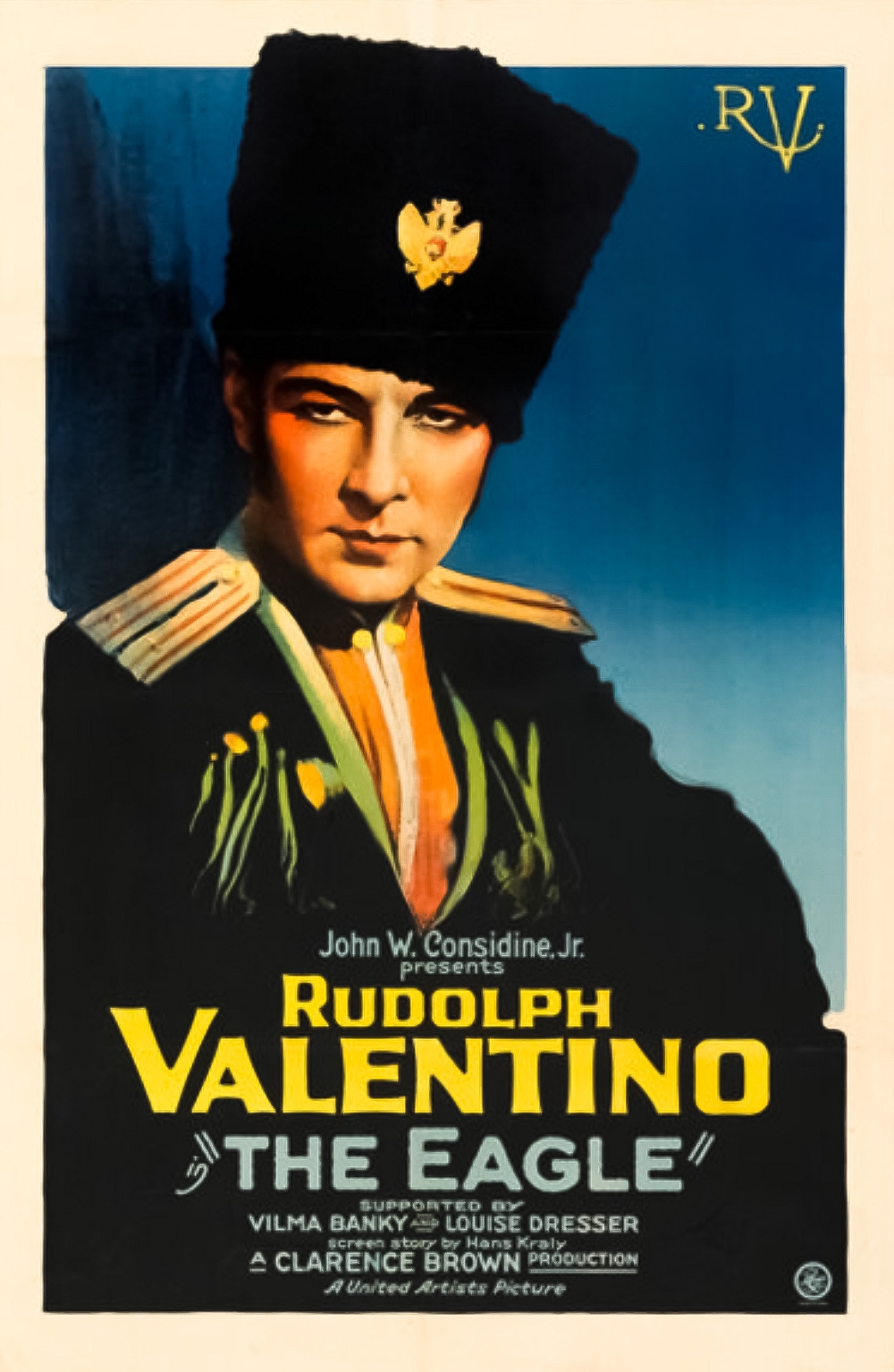
Rudolph Valentino made The Eagle in 1925 and while it wasn’t a smash along the lines of Blood and Sand or The Sheik, it did better than his previous four films – it was a comeback of sorts, and came not long before Valentino was whisked to the place from which no comeback is possible, after contracting peritonitis and dying.
Death is on the cards in The Eagle too, an adaptation of a Pushkin story about a young hussar who is spotted by the libidinous Czarina Catherine II and offered a place in her bed. But young, handsome and proud Vladimir Doubrovsky (the name is spelt a number of ways on screen) doesn’t fancy warming the older woman’s nethers. So he flees, incurring the Czarina’s wroth and earning himself a warrant for his arrest – dead or alive.
In other news, Doubrovsky’s father has been swindled out of all his property and possessions by dastardly tyrant Kyrilla Troekouroff. Vladimir decides to avenge his father and dons a Zorro-like disguise of black mask. And so is born the Black Eagle (the film’s original title, till the studio got wind of Douglas Fairbanks’s upcoming The Black Pirate). This helps Doubrovsky avoid detection by the Czarina’s guards, but makes little sense as part of the story since Vladimir spends most of the film in a second disguise, which he uses to insert himself into Kyrilla’s house as the French tutor to Kyrilla’s comely daughter, who he falls for quite badly.
Disguises, false identities, a raging father, a vengeful ruler, an impossible love across a murderous divide, it’s all quite torrid. Kyrilla, a violent drunkard, also keeps a bear in his wine cellar and one of his practical jokes is sending unwitting guests down there to fetch a special bottle of wine, with ugly consequences.
Fervid and romantic, action-packed and even funny, The Eagle dings most of the bells when it comes to the big Hollywood entertainment. Valentino is noticeably less kohl-besmeared than in previous films, less hooded of eye and more manly of bearing – the jibes were clearly hitting their target – and does quite a few of his own stunts, including the spectacular opening one where he chases down a runaway coach and leaps onto the speeding horses.

Director Clarence Brown is particularly good at action scenes like this but also has an eye for a pretty picture. This is a gorgeous film shot on lovely sets, with lighting which – not always the case in the 1920s – suits the mood. Action lit hard, romance lit soft. Brown is also something of a demon for camera balletics and there’s a shot that tracks backwards down a banquet table surrounded by revellers which is still a marvel to behold. There’s an explanation in the IMDb trivia of how he did it and it’s still not entirely clear just how it was achieved.
Brown shot a lot of Garbo’s films and so was obviously highly rated and his ability to tell his story visually cannot be over-emphasised. He has a light touch with a telling detail and an explicatory edit. This film is easy to follow and the fact that it’s silent doesn’t hobble it.
Other little touches help enormously. The costumes are lush, the supporting characters – Albert Conti as Vladimir’s witty, playful superior officer is particularly good – have on the whole been chosen for their expressive faces. Louise Dresser picks the short straw as the Czarina, all hot-bosomed and too old for young Dubrovsky/Dubrowski/Doubrovsky (take your pick, as she would like to), while James A Marcus is excellently wild as the brutal Kyrill.
Which just leaves Vilma Bánky as the love interest, Kyrilla’s daughter, Mascha. She’s probably the best thing in it and has a subtlety of touch that leaves Valentino in the dust. Though Valentino is far less mannered and theatrical than in some earlier films, he’s old school. Bánky’s sophistication is ahead of her time.
There are a lot of versions of this film out there, with all sorts of soundtracks accompanying them, including one by Carl Davis. The one I saw, by Kino Classics, came with a score by The Alloy Orchestra. It not only looks good – normal fluctuations for a film this age apply – but their score hits the various changes of mood and is expressive without being intrusive (I know some people hate the AO, but there you go).
All this in 73 breakneck minutes plus Gary Cooper, uncredited as a masked cossack. Score extra points for spotting him.
The Eagle – Watch it/buy it at Amazon
I am an Amazon affiliate
© Steve Morrissey 2025