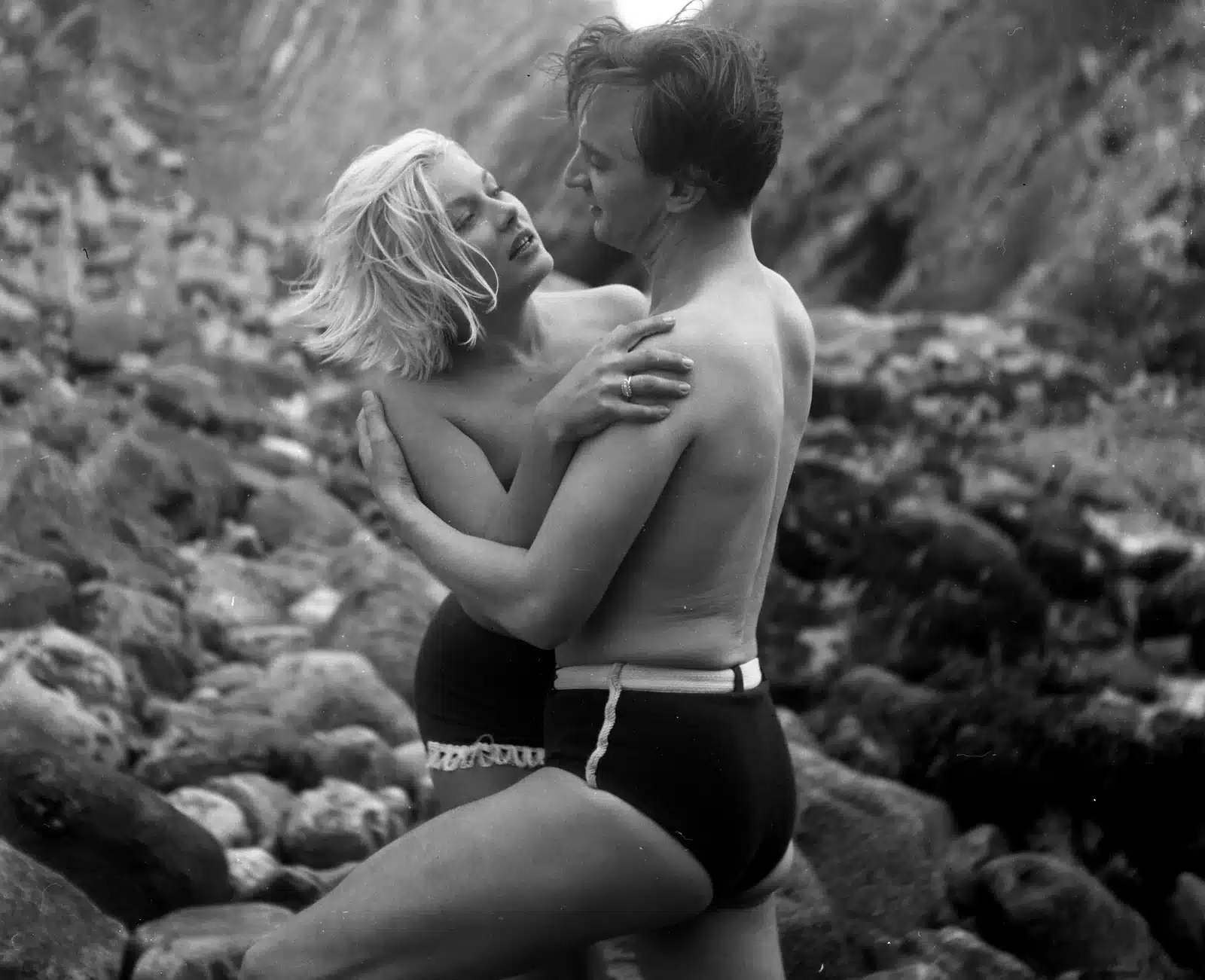
Four Sided Triangle is a British B movie from 1953. That’s two if not three knocks against it straight away. Look it up in the books and you’ll see it generally doesn’t get very good reviews. And yet it’s a really interesting film from all sorts of approaches.
It’s a kind of tweedy Frankenstein story, set in the bucolic English countryside, and introduced by a decent chap, a local doctor (James Hayter) who with rounded vowel sounds and in a voice like warm gravel recounts the story of two boys and a girl. Perhaps Robin and Bill were rivals for Lena’s affection even as kids, the flashback structure tells us, before Dr Harvey brings us up to the present day. After putting away their childish games, the boys grow up, go to Cambridge University and become scientists. The girl moves away to America, fails at whatever it was that she was doing, then returns to the half-timbered hamlet, where Robin and Bill are now in business together inventing weird scientific gizmos.
The girl is now played by Barbara Payton and has the trappings of the femme fatale – platinum blond hair, come to bed eyes – and she awakens the old rivalry in Robin (John Van Eyssen) and Bill (Stephen Murray). However, in adulthood as in childhood, it’s Robin who wins Lena’s affections. He has soon whisked her off to church and made her his bride, leaving Bill impotently pining on the sidelines.
The machine the two young men were working on though. It is a revolutionary device which clones things. Can you see where this is going? The lobby poster of the time fills in the details: “He outdid Frankenstein, and held strange powers… power to duplicate anything on earth… power to create this beautiful woman… power to satisfy his lust for passion!”
Yes. And no. You can forget the “lust” and “passion” bit – on the screen anyway, though the cadaverous Stephen Murray does a good job as a haunted, bookish adult so blown away by his desire for his childhood friend’s woman that he decides to clone her. The passion and the lust, such as they are, are all bottled up.
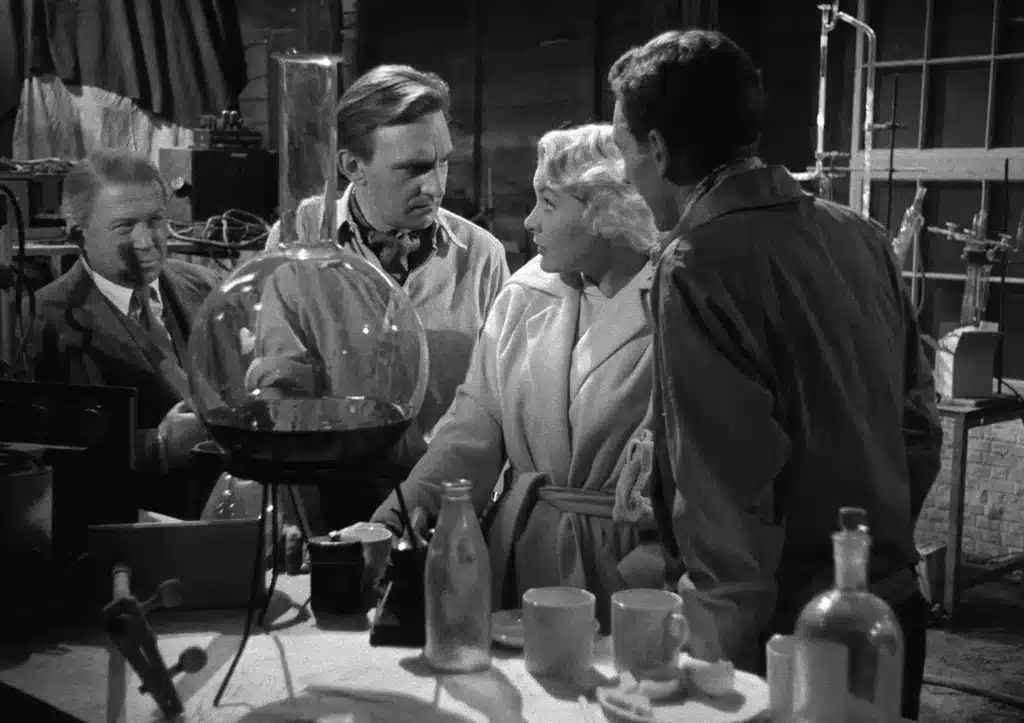
The director is Terence Fisher, here warming up for his stint as the Hammer Studio’s great horror auteur. He directs with deliberate nods to James Whale’s Frankenstein – arcing electricity, knobs and dials, much excited shouting in the lab – while the theremins and oscilloscopes blended with Malcolm Arnold’s crashing, Russian-inflected score work things up to a crescendo, particularly in the lab scenes (which are the best thing in the film).
At some level Four Sided Triangle also examines a theme Hitchcock gets so much credit for tackling in Vertigo – a controlling male fashioning a new woman to resemble the one he can’t have. It goes wrong for reasons similar to those in Vertigo. Bill, like James Stewart’s Scottie, is a dullard, and histrionic with it, a terrible combination almost guaranteed not to win the heart of fair lady.
Whether Lena – or Helen, as Bill calls his copy – is a fair lady is another question. No one seems too sure just how much of the femme fatale to inject into Payton’s rendering of Lena/Helen. Though that’s why you hire a bottle-blond American actress with a racy public image, isn’t it? But Lena/Helen is a largely blameless figure in this story, the prize in a dick-comparing competition lost by Bill before the tape measures have even come out.
Hammer Films have just restored this strange and undervalued film, which is ahead of its time in some respects, and much better than its reputation. I haven’t seen the restoration but the old version I watched was in pretty good shape, high production values being a Fisher trademark, and the new Collector’s Edition version has been done at 4K. I can’t guarantee it but it should look pretty damn spiffy. I’ve linked to it below.
Four Sided Triangle – Watch it/buy it at Amazon
I am an Amazon affiliate
© Steve Morrissey 2025

