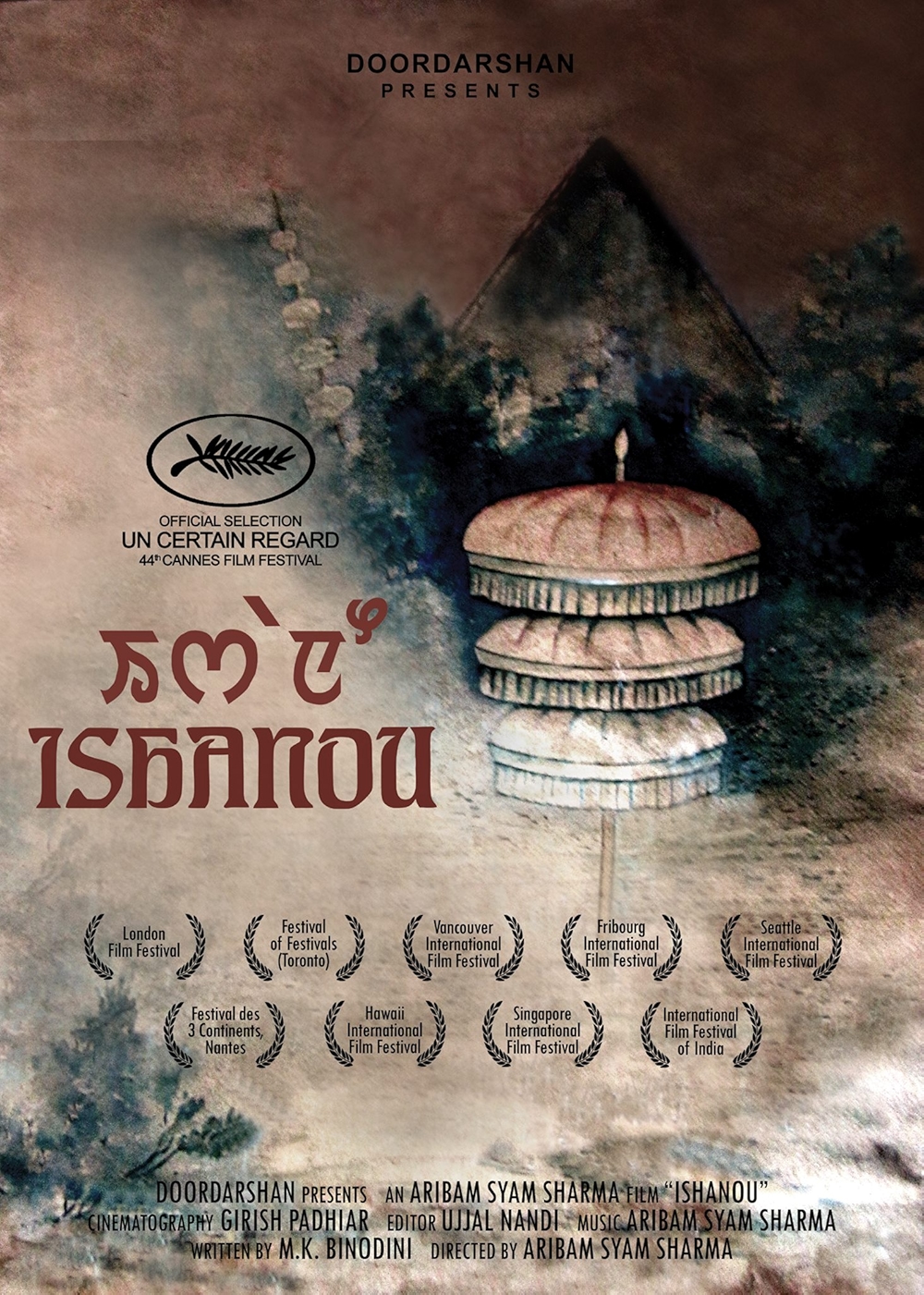
Manipuri cinema, from the state of Manipur in northwest India, only got going in 1972 and it’s pretty fair to say that Ishanou (The Chosen One) is either the most famous film ever to come from there or a contender for the title. Made in 1990 by Aribam Syam Sharma it’s a beautiful and deceptively simple drama shot on 16mm stock, which makes the whole thing gauzy and impressionistic and offsets an ethnographic element as fascinating as the story it tells.
A preamble gives us a structure for what’s to follow and fills us in on the background on the Maibis of Manipur, a religious order of sorts, whose female members are said to be chosen by “the deity”. Being a Maibi is onerous, comes loaded with duties and obligations and is not the sort of thing people wish for themselves, or so we’re told.
This out of the way, we cut to exactly that – the story of a beautiful young woman who lives with her husband, child and mother, who one day starts acting weirdly. Talking to herself, dancing for no reason, jumping into the river and reciting poetry, Tampha (Aboubam Kiranmala) also stops being interested in her husband’s physical advances, no longer applauds when he gets a promotion at work and breaks into a sweat when her mother brings live fish home to cook.
The problem is either medical, or psychological, her husband surmises (cue several scenes with the men in white coats) or possibly there’s a disturbance in her horoscope, her mother suggests. Eventually, after becoming extremely disturbed, and as if driven by an unseen hand, Tampha runs away in the night to a Maibi temple. The priestesses recognise immediately what’s ailing her.
In another culture this might be a story of demonic possession, of domestic abuse being escaped, or a psychological drama about hysteria. At certain points, when the highly distressed Tampha is thrashing around on her bed in the family home, The Exorcist seems to be the closest point of reference. Sharma has surely seen it.
But Tampha’s home life isn’t too bad. Husband Dhanabir (Kangabam Tomba) seems mesmerised by her. Her mother not too bossy. Tampha loves her daughter, Bembem. Sharma shows us the details without suggesting what to make of them. He leaves all the angles in play, including the one that Tampha has quite simply been chosen by “the deity”.

There are two juxtaposed styles in this film. In documentary mode we see how Tampha, Dhanabir et al live and what their daily lives consist of. But Sharma lards these with moments of impressionistic beauty. Suddenly the lighting is soft and the framing is careful. The score of flutes, drums and the the pena (a one-stringed Manipuri instrument) loads everything up with dramatic weight. There are moments of extremely touching acting too, like the scene where Dhanabir goes to the Maibi temple to get his wife back and finds her dancing with the other women there. He sees this and he knows. In one little gesture Tomba gives us the enormity of Dhanabir’s realisation, no words necessary. He’s lost her.
The main roles are taken by actors but most of the rest of the cast are just ordinary people. I don’t know if the Maibis are played by real Maibis but I am betting they are (non-Maibi locals were wary of taking on a role, apparently, for fear of becoming a Maibi themselves).
The Second Run Blu-ray, from the 4K restoration by India’s Film Heritage Foundation, comes with the dreaded “best surviving elements” disclaimer. The original 16mm negative was in poor shape, apparently, but it has cleaned up surprisingly well, and there’s only the odd soft scene to suggest where next-generation elements have been resorted to. A beautiful and fascinating film, whatever condition it’s in.
Ishanou – Watch it/buy it at Amazon
I am an Amazon affiliate
© Steve Morrissey 2025