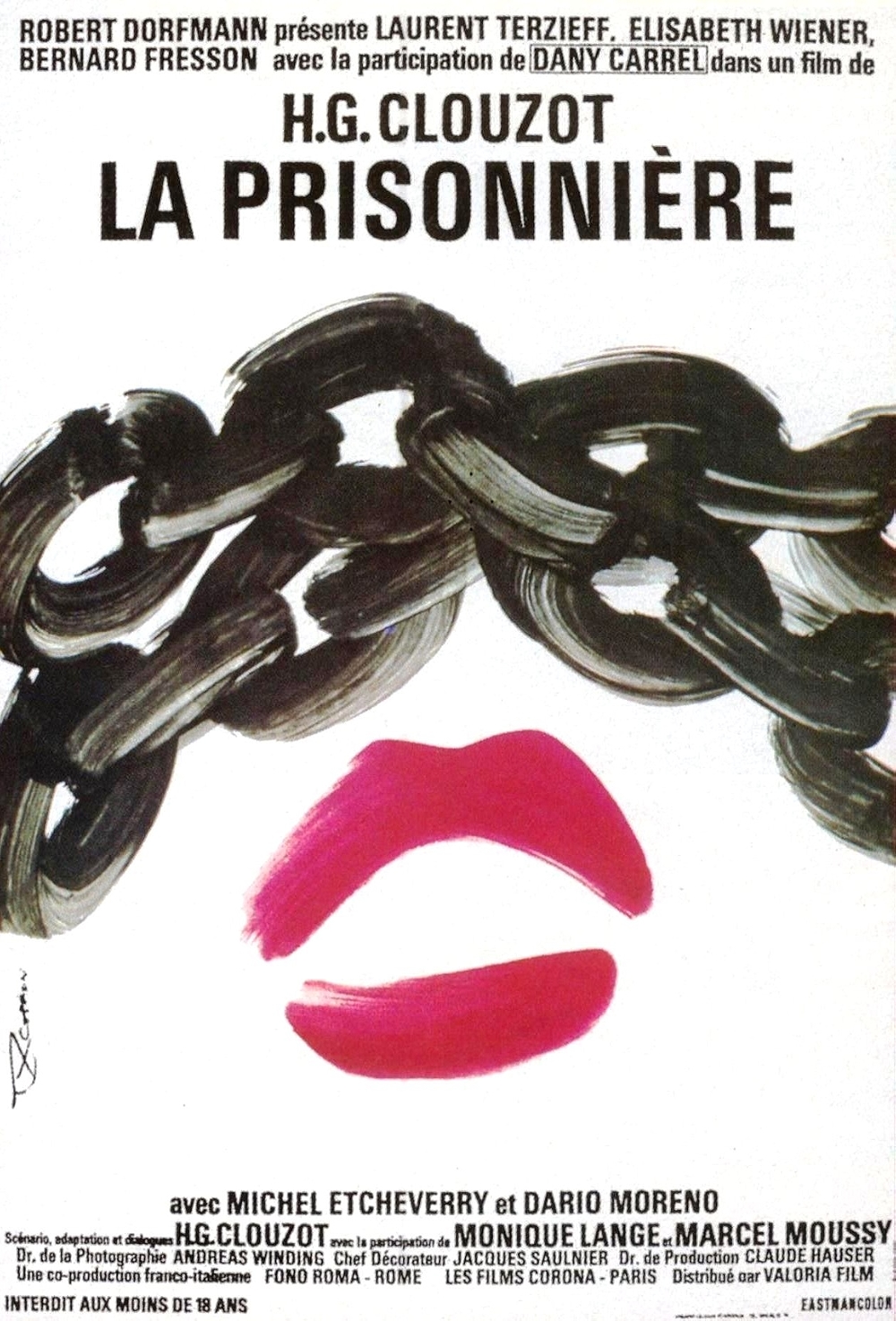
To that list of 1960s films about voyeurism add La Prisonnière, the great Henri-Georges Clouzot’s last film, his only (completed) one in colour and a worthy, if weird entrant in the canon containing Psycho, Peeping Tom and Blowup.
There is definitely something very, very Hitchcock going on in this offering from 1968, made when Hitchcock had gone off the boil. And so had Clouzot, to be honest, though Clouzot has the edge on his old rival here.
Looking, seeing, watching but not taking part is one of the ideas. Alongside a vague discussion about women’s complicity in their own enslavement in the story of a TV editor who becomes fascinated with a gallery owner whose hobby is taking photographs of women in bondage gear. They are tame pictures, let’s be clear, but racy enough to intrigue Josée (Elisabeth Wiener), a self-proclaimed liberated modern women who lives in the suburbs with artist husband Gilbert (Bernard Fresson) and is keen not to be seen as a little wifey. And so she starts a funny sort of relationship with the cold and aloof Stanislas (Laurent Terzieff). She thinks she’s being bold and daring, though all the time she’s trying to tame him and mould him into her idea of a perfect man. Which is a perfect suburban man, it turns out, because no matter what she tries Josée cannot escape her origins. The film is not called La Prisonnière (Woman in Chains, in English) for nothing.
A reverse Vertigo is partly the idea. Clouzot’s camera is male-gaze oriented, as Hitchcock’s was, regularly gliding up and down Josée’s body as he opens his war chest of Freudian psychoses, to add a layer of complexity to his Buñuelesque bourgeoisie-baiting.
Later, Stanislas’s latest model, Maguy (Dany Carrel), arrives on the scene. She’s a woman who is the same height, build and colouring as Josée. And so doubling also arrives as a theme, as does the sense that we’re meant to be convinced that “something important” is being said.

The TV editor, her artist husband and her voyeur would-be lover. All people defined by what they look at. Suburban moralists against cosmopolitan perverts. Sick bourgeois types never happy with what they have. Women who have crawled halfway out of the box and are now willing themselves back into it again. Clouzot is tick-boxing away at a list of 1960s tropes. He does it stylishly, with Hitchcockian colourways and framing. Though much of it takes place in apartments, galleries on opening nights and in the TV editing suite where Josée watches footage of tearful women crying over abusive men, Clouzot even gives us a Hitchcockian set piece in what looks like a finale set on a rooftop.
This turns out to be a false alarm. The real finale is a bravura and quite trippy montage of flashes of colour intermingled with snapshots of bondage gear, African fetish, nudity and violence. It’s another of Clouzot’s attempts to re-invent the language of film, which he’d also attempted in the never-finished Inferno, his rebuff to the New Wavers who thought he was past it.
He was past it, and trying too hard is the sign of that. But he is trying, he’s still a consummate film-maker and his characters are not quite the Freudian placeholders they at first seem to be – there is movement, development.
It’s a fascinating film, and beautifully made, though watching leaves the same lack of fulfilment as watching late Hitchcock. The touch that manifests itself in every movement (or not) of the camera has been replaced by something more studied and far less convincing.
La Prisonnière (Woman in Chains) – Watch it/buy it at Amazon
I am an Amazon affiliate
© Steve Morrissey 2026