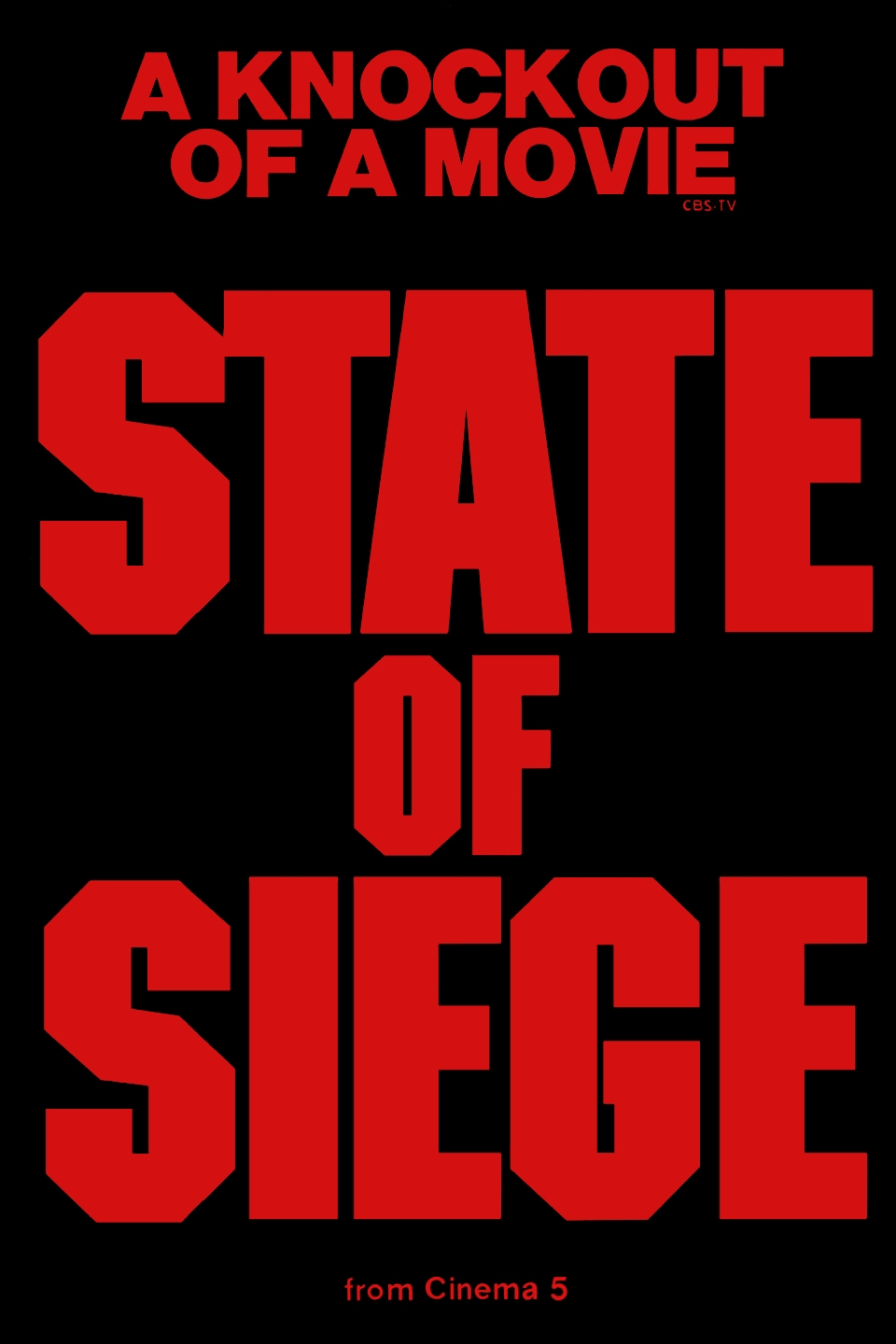
The last of three political thrillers made by Costa-Gavras, State of Siege, along with Z and The Confession, are the linkers between political thrillers of the early 1960s and the more celebrated clutch of the 1970s. Mixing the geopolitics of the likes of 1962’s The Manchurian Candidate with the paranoia of 1974’s The Parallax View and its ilk, his 1972 thriller manages to be both paranoid and geopolitical, but most of all it’s procedural – Costa-Gavras wants to know the who and the what but also the how of moments of great political flux.
He starts off with the discovery of the body of a dead American diplomat in a car, widens his focus to the attendant political hoo-hah in the South American country where the man’s death occurred and then goes back in time, to the kidnapping of Philip Michael Santore (Yves Montand), an innocent abroad, it’s claimed.
In fact Santore is a professional political agitator working for the US government to destabilise regimes, a fact that will emerge during extended interrogation of Santore by his masked inquisitor, Hugo (Jacques Weber), who actually knows all the answers to the questions he’s asking, but wants to hear them first-hand from his captive’s mouth. More peripherally Costa-Gavras introduces us to Captain Lopez (Renato Salvatori), the cop charged with rounding up the guerrillas, no questions asked, and Ducas (OE Hasse), a crusading journalist trying to carry on as a man like him should in a “democracy” – sceptical of authority, asking questions, writing stories.

This is Costa-Gavras’s swing at making a movie like The Battle of Algiers, the stunning 1966 pseudo-documentary directed by Gillo Pontecorvo. Costa-Gavras is working off a screenplay by the same writer, Franco Solinas, and is using the same techniques as Pontecorvo: long lenses to suggest surveillance, extreme documentary realism with his extensive use of god’s-eye-view crowd scenes to set the mood, and an urgent aesthetic of dirt, sweat and chaos.
To this end the rough-edged Montand is perfect casting, especially once Santore starts pushing back against Hugo’s revolutionary idealism, in scenes where he suggests that conservative men’s men like him are what make the world go round, rather than the effete likes of progressives and revolutionaries like Hugo and his gang. Santore is allowed to give a good account of himself, in what are the film’s most effective scenes.
The irony is that the film is set in Uruguay, where in 1970 a USAID official called Dan Mitrione (the basis for the Santore figure) was killed by a guerrilla group. But, Uruguay being too dangerous to film in, Costa-Gavras shot his film in Chile, where not long afterwards a coup clandestinely supported by the US government would oust democratically elected President Allende and replace him with General Pinochet. Life mirrors art mirroring life.
Costa-Gavras bends over backwards to suggest that the revolutionaries are decent people. In a strange scene, they take Santore to hospital to have a gunshot wound sustained during his capture looked at by doctors – Santore drugged so he can’t try to escape. And in other scenes dropped in so we understand who we’re meant to be rooting for, a demonstration of the regime’s torture techniques to a roomful of apprentice torturers – a man strapped in a chair has electrodes applied to penis, nipple, inside his lip, the eyes.
It’s all very unromantic, grim, no glam, no heroes and even the villains are shadowy. Costa-Gavras wants sobriety and procedure to carry the day and even when stirring emotion is being expressed, it’s done without histrionics.
The South American perspective on political paranoia is refreshing and the fact that it’s based on reality give it a relevance that the likes of Parallax or Day of the Condor can only dream of. And yet, for all its many pluses, does it really work? It’s an achievement, for sure, but Costa-Gavras never quite breaks out of the shadow of The Battle of Algiers and by following its style so closely he makes precisely what he was trying to avoid – a movie in the style of another, ie a genre movie. A good one, it must be said, though you might find yourself asking why Solinas and Costa-Gavras didn’t go the whole generic hog and beef up the role of Hosse’s not-quite-crusading journalist Ducas rather than have him flap around ineffectually at the edges. Too Hollywood? Probably.
State of Siege – Watch it/buy it at Amazon
I am an Amazon affiliate
© Steve Morrissey 2026